



The purchase price is only the first line in an e-bike budget. Ongoing ownership can include charging, tyres, brake parts, drivetrain wear, servicing, security, insurance, storage and, eventually, battery or electronic replacement.
That does not mean e-bikes are unusually expensive to own. It means the sticker price is a poor way to compare them. Two bikes with similar purchase prices can have very different long-term costs if one uses hard-to-find tyres, a proprietary battery, uncommon brake parts or a service system that is difficult to access.
If you are still comparing bike types, start with the current Wallke electric bike range in Europe and use the framework below on any model you shortlist. The aim is not to find the cheapest bike. It is to avoid buying a bike whose real cost only becomes obvious after the first few months.
What Counts as an E-Bike “Hidden Cost”?
A hidden cost is not necessarily a fee that a seller has concealed. It is any ownership expense that is easy to miss when you focus only on the purchase price.
For most riders, the real cost of owning an e-bike falls into three groups:
- Upfront extras: lock, helmet, luggage, mirrors, tools, weather protection or secure storage.
- Recurring running costs: electricity, servicing, tyres, brake pads, drivetrain parts and insurance where relevant.
- Occasional larger costs: battery, charger, display, controller, motor-related repairs or other model-specific parts.
| Cost | When it appears | What changes the cost | What to check before buying |
|---|---|---|---|
| Security and basic accessories | Mostly upfront | Parking risk, commute needs, cargo and weather | Locking points, rack compatibility, lights and storage |
| Electricity | Ongoing | Battery size, charging frequency and local tariff | Battery energy in Wh/kWh and your electricity price |
| Tyres and tubes | Wear-dependent | Tyre size, mileage, load, pressure and road surface | Exact size, local availability and replacement price |
| Brake parts | Wear-dependent | Bike mass, descents, riding style, load and conditions | Pad and rotor type, availability and workshop access |
| Chain, cassette and drivetrain | Wear-dependent | Mileage, dirt, lubrication, load and shifting habits | Whether standard replacement parts are readily available |
| Routine servicing | Periodic | Usage, local labour rate and service complexity | Service route, diagnostic needs and maintenance schedule |
| Battery replacement | Long-term / condition-dependent | Capacity, design, age, storage, usage and availability | Exact replacement battery price and supply route |
| Insurance, storage and transport | Ongoing or situational | Country, bike category, theft risk and living situation | Local rules, insurance terms, secure parking and bike weight |
1. Battery Replacement Is the Cost Most Buyers Forget to Price
The battery is one of the most expensive individual parts on an e-bike. It is also a consumable component in the long term. Capacity falls with use and age, and a damaged or failed battery can turn a cheap e-bike into an expensive ownership problem if a compatible replacement is difficult to source.
Do not rely on a universal claim such as “an e-bike battery lasts X years”. Battery life depends on cell chemistry, charging habits, storage temperature, depth of discharge, usage pattern and the battery management system. The useful question before buying is simpler:
- What does a replacement battery for this exact model cost today?
- Can you buy it directly from the manufacturer or an authorised source?
- Is the mounting system proprietary?
- Is the charger also readily available?
- What happens if the battery develops a charging fault outside warranty?
If a battery will not charge, diagnose the charging chain before assuming the cells are dead. Wallke owners can use the e-bike battery not charging troubleshooting guide as a starting point.
2. Tyres, Brakes and Drivetrain Parts Are Small Costs That Repeat
Mechanical wear is easy to underestimate because no single tyre, brake pad or chain looks as expensive as a battery. Over time, repeated replacement can matter more than the charging bill.
Tyres and tubes
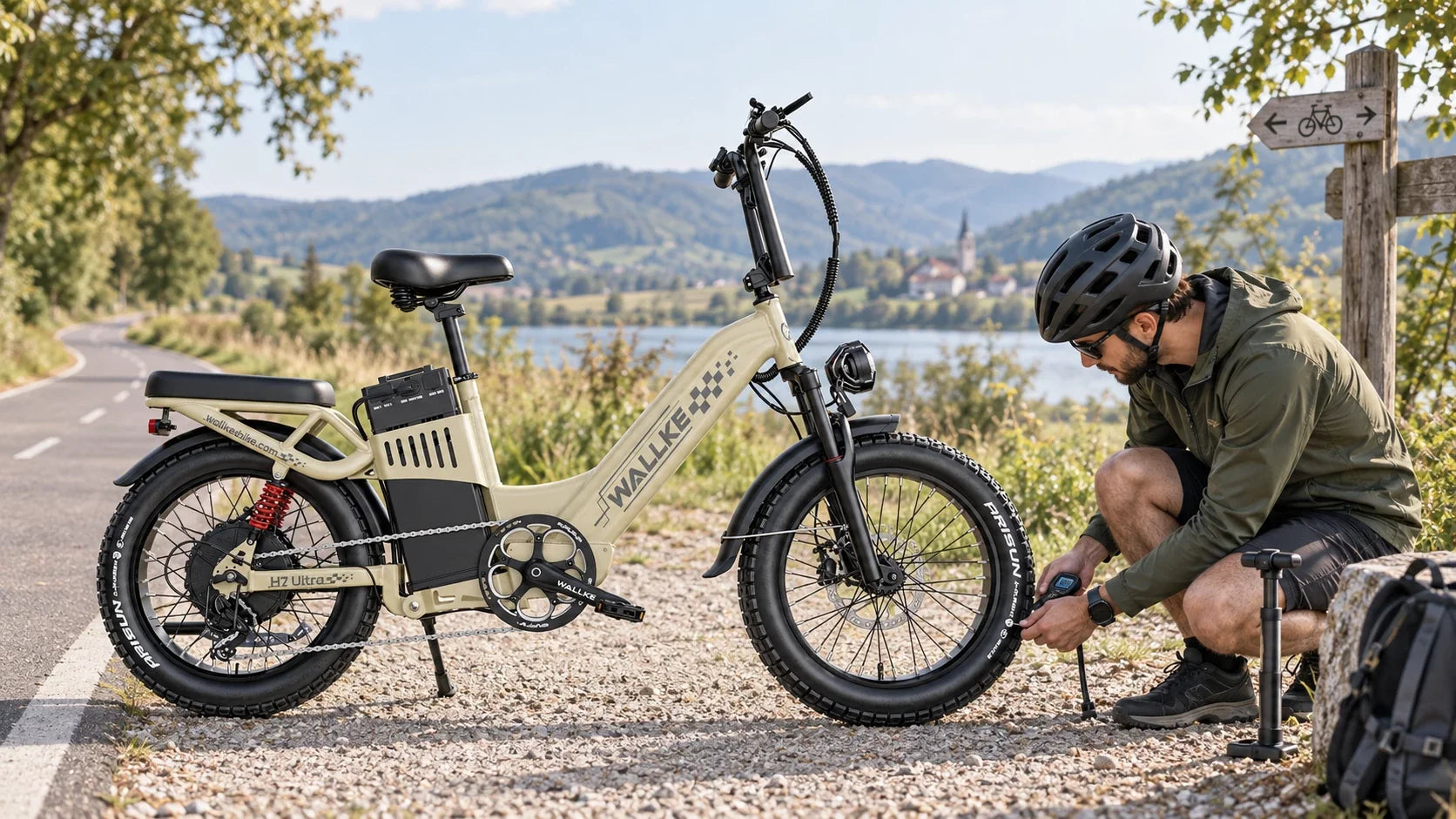
Check the exact tyre size before buying. Common sizes are usually easier to source. Very wide, unusual or model-specific tyres can reduce your choice and may cost more locally. Riding with incorrect pressure can also increase wear and puncture risk.
Brakes
E-bikes are often heavier than comparable non-electric bikes. More total mass, higher mileage, steep descents and frequent stop-start riding can all increase brake wear. Before buying, identify the pad type and rotor size rather than waiting until the first replacement is needed.
Chain, cassette and other drivetrain parts
Wear depends heavily on use. Mud, neglected lubrication, high load and poor shifting can shorten service life. For a high-mileage commuter, predictable access to chains, cassettes and derailleur parts can be more valuable than one extra headline feature.
3. Service Cost Depends on the Bike, the Workshop and What You Can Do Yourself
A single annual maintenance figure is rarely useful across Europe.
A rider who cleans and lubricates the drivetrain, changes pads and fixes punctures at home will have a different labour bill from someone who pays a workshop for every task. An e-bike that requires brand-specific electronic diagnostics can also be harder to service than one whose mechanical parts are familiar to local bike shops.
Before buying, ask:
- Can a normal bicycle workshop service the brakes, wheels and drivetrain?
- Who diagnoses electrical faults?
- Are the display, controller, sensors and wiring available as separate parts?
- Will unauthorised electrical modification affect the warranty?
- Do you need to ship the bike or a component back for diagnosis?
For Wallke models, check the current warranty terms before buying. The page distinguishes manufacturing defects from normal-wear items such as tyres, tubes, brake pads, chains and spokes. Normal wear items are often excluded from commercial warranties, so check the brand’s current terms. For purchases in the EU, statutory consumer rights apply separately from any manufacturer or commercial warranty; EU rules provide at least a two-year legal guarantee for goods, while national details can provide additional protection.
4. Charging Costs Are Easy to Calculate — So Calculate Your Own
Electricity is one of the easiest running costs to estimate. Do not copy a figure from another country. Use your own tariff.
Battery energy in kWh × equivalent full charges per year × local electricity price per kWh = approximate battery energy cost.
For more precision, use actual wall-socket consumption because the charger and battery are not 100% efficient.
This also explains why “cost per mile” or “cost per kilometre” figures from another rider can be misleading. Assist level, hills, wind, temperature, load, tyre pressure and riding speed all change energy use.
5. Security and Insurance May Matter More to Your Budget Than Charging
A high-value e-bike needs a realistic theft plan. That can mean a better lock, secondary lock, ground anchor, secure indoor storage or insurance. These are not glamorous purchases, but they are part of total cost of ownership.
Insurance rules and products vary across Europe. The exact vehicle category can also matter. Check the requirements and policy terms in the country where you ride instead of assuming that every vehicle sold as an “e-bike” is treated the same way.
When comparing insurance, read the conditions. Some policies specify approved locks, where the bike may be left, how it must be secured and whether accessories or batteries are covered.
6. Accessories Become Expensive When You Buy Them Twice
Most riders need more than the bike itself. The first-year budget may include a helmet, lock, bags, phone mount, pump, tools, waterproof cover, mirrors or additional lights.
The cost problem is not always the accessory price. It is compatibility. A rack bag that does not fit, a child seat that the rack is not rated for, or a charger bought only because the original cannot be sourced can turn a small purchase into waste.
Make a list before ordering. Buy the essentials first. Add comfort upgrades after you have ridden the bike long enough to know what is actually missing.
7. Storage and Transport Are Ownership Costs Too
Bike weight becomes a cost when your home, office or vehicle does not suit it. A heavy e-bike may require a stronger vehicle rack, ground-floor storage or help lifting it. A folding frame can reduce length, but it does not automatically make a bike light.
If storage space is a key part of your decision, compare the practical differences in Wallke’s folding e-bike range. Check folded dimensions and complete weight, not the word “folding” alone.
8. Return Terms and Warranty Exclusions Can Create Unexpected Costs
Large or heavy e-bikes can be expensive to return or transport. A return that looks simple on a product page can become costly if the buyer is responsible for return freight, repacking or other return conditions.
Read the policy before you order, especially if you are unsure about fit, access to your building or the bike’s weight. Wallke’s current European return policy sets out conditions for returns, shipping responsibility and non-returnable items. For EU online purchases, statutory withdrawal and consumer rights apply separately from a retailer’s commercial return policy. Consumers generally have a 14-day right of withdrawal for distance purchases, subject to legal exceptions and conditions. Policies and rules can change, so check the live terms and the consumer rules that apply where you buy.
9. Your Riding Style Changes Which Costs Matter Most
There is no single “average rider”. The hidden costs of an e-bike depend on how the bike is used.
Daily commuting
Regular mileage makes consumables more important. Tyres, brake pads, drivetrain wear, wet-weather maintenance and secure parking deserve more attention than occasional accessories.
Fat-tyre riding
Wide tyres can add grip and comfort on mixed surfaces, but the exact tyre and tube size affects replacement choice and cost. Before buying, check whether suitable replacements are easy to source where you live.
Off-road use
Mud, loose surfaces, steep descents and impacts can increase maintenance demand. Brake, tyre, wheel and drivetrain condition matter more when the bike regularly leaves smooth roads. Budget for the way you will actually ride rather than the easiest route.
10. How to Estimate Your Own Annual E-Bike Running Costs
Instead of searching for one average number, build a simple personal budget.
electricity + routine service + expected wear parts + insurance/security + storage/transport + long-term component reserve.
For occasional expensive parts, spread the risk across the years you expect to keep the bike:
expected replacement cost ÷ planned ownership years = annual reserve.
This is a budgeting tool, not a prediction that the part will fail in a specific year.
Keep the estimate personal. Someone riding 1,000 km a year on dry cycle paths should not use the same maintenance budget as a high-mileage commuter riding through winter.
11. The Cheapest E-Bike Can Be Expensive for the Wrong Reason
Low purchase price is not automatically a red flag. Missing information is.
Be cautious when you cannot confirm:
- the exact replacement battery and charger;
- common tyre, tube and brake-pad sizes;
- the complete bike weight and how you will store it;
- who handles electrical diagnostics;
- whether key electronic parts can be replaced separately;
- the warranty exclusions for normal wear;
- the return process and possible freight responsibility;
- support availability in the country where you live.
A bike with clear documentation, common consumables and a realistic parts route can be easier to own even if another model costs less at checkout.
A Pre-Purchase Checklist for Lower Long-Term Costs
- Price the exact replacement battery.
- Check charger availability.
- Write down tyre and tube sizes.
- Identify brake pads and rotors.
- Check chain and cassette compatibility.
- Find a realistic mechanical service route.
- Confirm who handles electrical faults.
- Read warranty exclusions.
- Read return-shipping conditions.
- Measure your storage space.
- Check the bike’s complete weight.
- Budget for secure locks and parking.
- Check local insurance requirements.
- Calculate charging with your own tariff.
If you already own a Wallke and are investigating a fault, start with the Wallke e-bike troubleshooting page before buying replacement parts. Diagnosis first is cheaper than replacing components by guesswork.
Final Takeaway: Compare Ownership, Not Just Purchase Price
The cheapest bike to buy is not always the cheapest bike to own. Compare replacement parts, service access, warranty terms, security, storage and charging alongside the purchase price.
The better-value bike is the one that fits your use and remains practical to maintain, repair, store and support over the years you intend to own it.
Frequently Asked Questions
What are the hidden costs of owning an e-bike?
The main hidden costs are usually wear parts, servicing, charging, security, insurance where relevant, accessories, storage or transport, and occasional replacement of expensive electrical components such as the battery, charger, display or controller. The exact mix depends on how and where you ride.
Which maintenance costs should I include in an e-bike ownership budget?
Include routine servicing, tyres or tubes, brake parts, drivetrain wear and a long-term reserve for larger components such as the battery. Your actual total will depend on mileage, terrain, weather, local labour rates and how much maintenance you do yourself.
How much does it cost to charge an electric bike?
Use your own electricity tariff rather than a generic figure. Multiply the battery energy in kilowatt-hours by the number of equivalent full charges and your local price per kWh. Real wall-socket consumption will be somewhat higher because charging is not perfectly efficient.
How much does an e-bike battery cost to replace?
Replacement prices vary too widely by battery size, brand, mounting system and availability to give one useful Europe-wide number. Before buying, check the current replacement-battery price for the exact model, how replacement batteries are ordered, and whether the manufacturer publishes any long-term parts-support information.
How often should an e-bike be serviced?
There is no single interval that suits every e-bike. Follow the manufacturer’s schedule and inspect the bike more often if you ride frequently, carry heavy loads, ride in rain or mud, or notice changes in braking, shifting, wheel condition or electrical behaviour.
Is an e-bike still worth it after maintenance and running costs?
That depends on what the e-bike replaces and how often you use it. Compare the complete ownership cost with your real alternative, such as a car, public transport or a conventional bicycle. Include purchase price, maintenance, charging, security, storage and expected replacement parts rather than comparing purchase prices alone.
How can I avoid unexpected e-bike ownership costs before buying?
Check replacement battery and charger availability, common tyre and brake sizes, drivetrain parts, service options, warranty exclusions, return-shipping terms, complete bike weight and storage needs. A lower purchase price can be poor value if the bike is difficult to repair or requires proprietary parts that are hard to source.
Leave a comment