



A 20-inch e-bike can be a practical adult bike. A 26-inch e-bike may feel more settled over rough ground. Neither is automatically more comfortable, lighter or easier to store. The right choice comes down to the complete bike—not just the wheels.
If you are weighing up a 20 vs 26 inch ebike, start with your everyday route. Think about uneven streets, the lift at home, where the bike will be parked and how easily you can get on and off it. If you are specifically shopping for wide tyres, you can also compare fat tyre e-bikes after you have narrowed down the wheel size and frame style.
20-inch vs 26-inch e-bikes: the differences at a glance
| Buying question | 20-inch e-bike | 26-inch e-bike |
|---|---|---|
| What does the number describe? | A nominal wheel/tyre size, not the frame size | A nominal wheel/tyre size, not the frame size |
| Ride over bumps | Can need more attention on larger edges; fat tyres and suspension help | Larger effective wheel diameter can help smooth obstacle rollover |
| Low-speed handling | Often feels lively on suitably designed bikes | Often feels more gradual on suitably designed bikes |
| Adult rider fit | Depends on saddle range, reach and frame geometry | Depends on saddle range, reach and frame geometry |
| Folding and storage | Folding models are available; some are not foldable | Folding models also exist; check the actual dimensions |
| Weight and carrying | Not necessarily light, especially with fat tyres and large batteries | Not necessarily heavier; components matter more than wheel size alone |
| Range and speed | No automatic advantage | No automatic advantage |
These are general design tendencies, not the results of a controlled ride test. Two bikes with different tyres, suspension, motors and geometry cannot be ranked fairly by diameter alone.
First, what does “20-inch” or “26-inch” actually mean?
The figures are conventional tyre-size labels. They do not tell you the height of the frame, the distance to the handlebars or the full length of the bike. They are also not precise measurements of the mounted tyre's outside diameter.
A marking such as 20 × 4.0 describes a nominal 20-inch tyre format and approximately 4-inch tyre width. For replacement parts, the ETRTO marking on the tyre sidewall is more useful. It identifies the tyre's width and bead-seat diameter in millimetres. Schwalbe's tyre-size guide explains why inch labels alone can be ambiguous.
This matters because a 20-inch fat-tyre e-bike is quite different from a lightweight 20-inch city folder. Comparing only the big number on the tyre can hide more important differences.
How different do 20-inch and 26-inch e-bikes feel to ride?
On potholes, kerbs and rough paths
All else equal, a wheel with a larger effective outside diameter meets a small obstacle at a shallower angle. That is one reason a 26-inch design may roll over broken surfaces more easily.
But tyres and suspension change the picture. A high-volume 20 × 4.0 tyre at an approved pressure may soften small bumps. A narrow, hard tyre on a larger wheel may feel less forgiving. Tread, fork, wheelbase and riding position matter too.
In town, at junctions and around tight corners
Some riders enjoy the responsive feel of a smaller-wheel bike. Others prefer the more gradual steering of a larger-wheel setup. Handlebar width, head angle, fork offset, wheelbase and weight distribution also shape this feeling.
Do not buy a 20-inch e-bike on the promise that it will always turn more sharply. Ask to try a slow U-turn, a tight parking manoeuvre and a normal stop-and-start ride.
On hills, at speed and over longer distances
Wheel diameter can affect gearing and the way obstacles are approached, but it does not set an e-bike's top speed or battery range. Assistance limits, motor characteristics, gearing, tyres, route gradient, total load and weather all play a part.
A 26-inch e-bike is therefore not automatically faster or longer-range. Nor does a 20-inch e-bike always accelerate better. Compare the exact models, then test the kind of riding you expect to do.
Can adults ride a 20-inch e-bike? What about tall riders?
Yes. A 20-inch electric bike for adults can fit a wide range of riders when the frame is designed for them. It is not the same thing as a child's 20-inch bicycle.
Equally, 26-inch wheels are not reserved for tall adults. A smaller rider may fit a well-designed 26-inch frame better than a badly proportioned 20-inch model.
Check these three measurements separately:
- Standover and frame access: Can you get on, get off and stop comfortably?
- Minimum and maximum saddle height: Can you reach the pedals correctly and start and stop with confidence?
- Reach and handlebar adjustment: Can you steer and brake without stretching?
A good illustration comes from two Wallke electric bikes for adults using the same 20 × 4-inch tyre format. The published H7 AWD dimensions list a 50 cm standover and 88 cm minimum saddle height. The H9 AWD lists a 70 cm standover and 86 cm minimum saddle height. They share the same nominal wheel size, yet getting on and finding a comfortable position are different questions.
The listed recommended rider heights also start at 174 cm for both models. That is a useful warning: a smaller wheel does not guarantee that a shorter adult will fit. Confirm your inseam, fit range and preferred posture against the exact bike before ordering.
Is a 20-inch e-bike really smaller or easier to store?
Not always. This is one of the most expensive assumptions to make when buying online.
A real example: wheel size does not predict overall length
Wallke's 20-inch H7 AWD lists an overall bike length of 196 cm. As a separate, cross-market example, the US-listed 26-inch ENGWE X26 specifies a length of 196.1 cm. The figures are effectively alike at the level of published manufacturer dimensions.
This is not a matched engineering test or an EU-model recommendation. Measurements and configurations may differ. It simply shows why you should not assume a bike is short because its wheels are small.
Folding is a frame feature—not a wheel-size feature
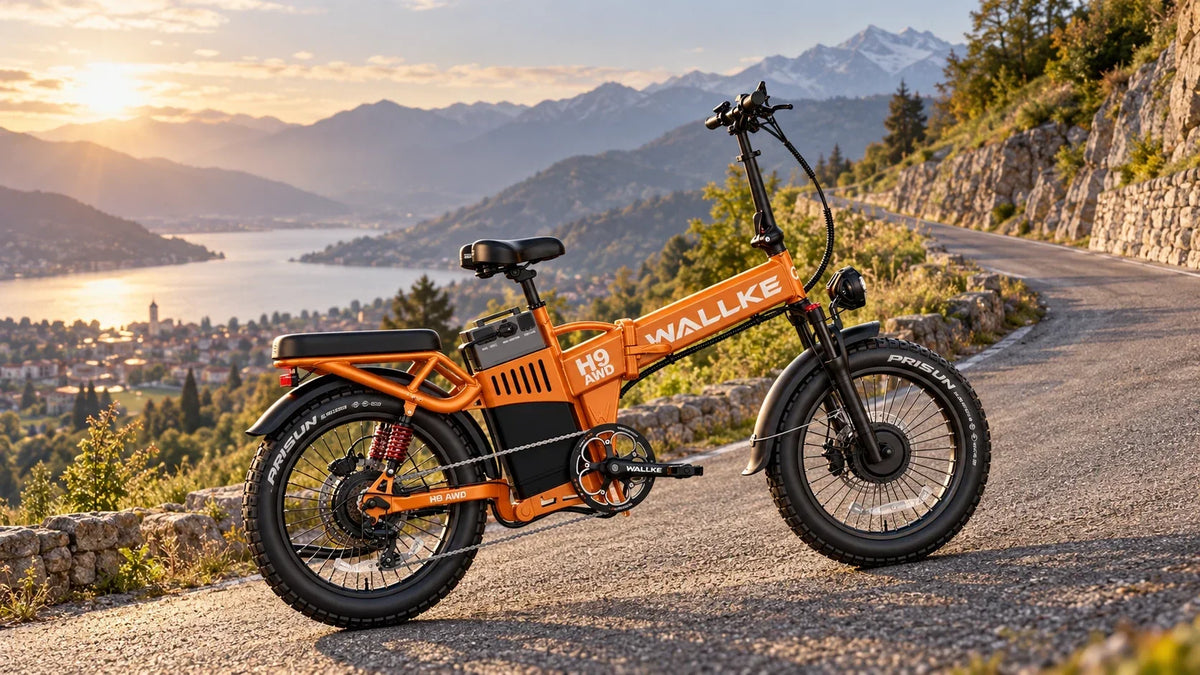
The 20-inch Wallke H7 AWD has a fixed step-through frame. The 20-inch Wallke H9 AWD has a folding step-over frame. Some 26-inch e-bikes fold as well, including the example above.
For the H9 AWD, the published folded size is approximately 102 cm long × 55 cm wide × 77 cm high. That is useful for planning, but it does not prove the bike will fit through your doorway or into your car. Hinges, pedals, handlebars and loading angles also matter.
For a dedicated guide to motorhome and campervan storage, see folding electric bikes for RV travel.
Measure your actual storage space before buying
- Measure the narrowest doorway, lift opening or car boot access—not just the space inside.
- Measure the usable internal length, width and height, allowing for shelves and other belongings.
- Check the bike's full dimensions and, if applicable, its folded dimensions for the exact variant.
- Check the complete ready-to-ride weight and whether you can lift or roll it safely. A folding hinge does not make a heavy bike easy to carry.
- Check any carrier or loading ramp's rated load, tyre-width clearance and securing method.
If carrying the bike upstairs is a daily task, prioritise a manageable complete weight over wheel diameter or folding claims.
20 × 4.0 vs 26 × 4.0 fat-tyre e-bikes
Wide tyres change the usual small-wheel versus big-wheel discussion. Both 20 × 4.0 and 26 × 4.0 formats provide a large tyre volume, although actual dimensions depend on the fitted tyre and rim.
20 × 4.0: worth considering when
- You prefer the feel of a smaller-wheel design.
- You have found a frame that truly fits your body.
- A particular folding model passes your storage checks.
- Your routes include town riding and occasional rough surfaces.
26 × 4.0: worth considering when
- Uneven tracks and repeated bumps are a regular part of the ride.
- You prefer a larger-wheel riding feel.
- You have room to store and manoeuvre the complete bike.
- The particular frame and saddle range suit your posture.
On gravel and firmer trails, compare tread, approved pressure range, suspension, brakes and total bike weight. For coastal sand, the surface and local access rules matter more than any simple 20-versus-26 verdict; see the fat-tyre e-bike guide for sand if that is your main use.
Which wheel size suits your everyday riding?
| Your situation | Best first question | Practical direction |
|---|---|---|
| Daily city commuting | Does it fit your body and parking space? | Either size; start with frame fit, brakes and storage, not wheel size |
| Broken tarmac or gravel tracks | How often do you meet larger bumps? | Consider 26-inch, while comparing tyre, suspension and geometry |
| Small flat, lift or narrow corridor | What is the complete bike's length and width? | Consider a genuinely compact or folding model in either wheel size |
| Campervan or car transport | Can you load its full weight and dimensions? | Measure first; folded size and lifting effort determine suitability |
| Frequent stops or limited leg mobility | How easy is it to mount and dismount? | Look at step-through access and standover, regardless of diameter |
| Rider who often carries a bike upstairs | Can you comfortably lift the entire bicycle? | A lighter design may beat either heavy fat-tyre option |
One discussion on r/ebikes framed the choice around city exploring, light trails and fitting a fat-tyre bike in an apartment lift. That is a more useful way to start than asking which diameter is universally more fun. Your own building and riding route should decide the shortlist.
Where Wallke's 20-inch e-bikes fit into the comparison
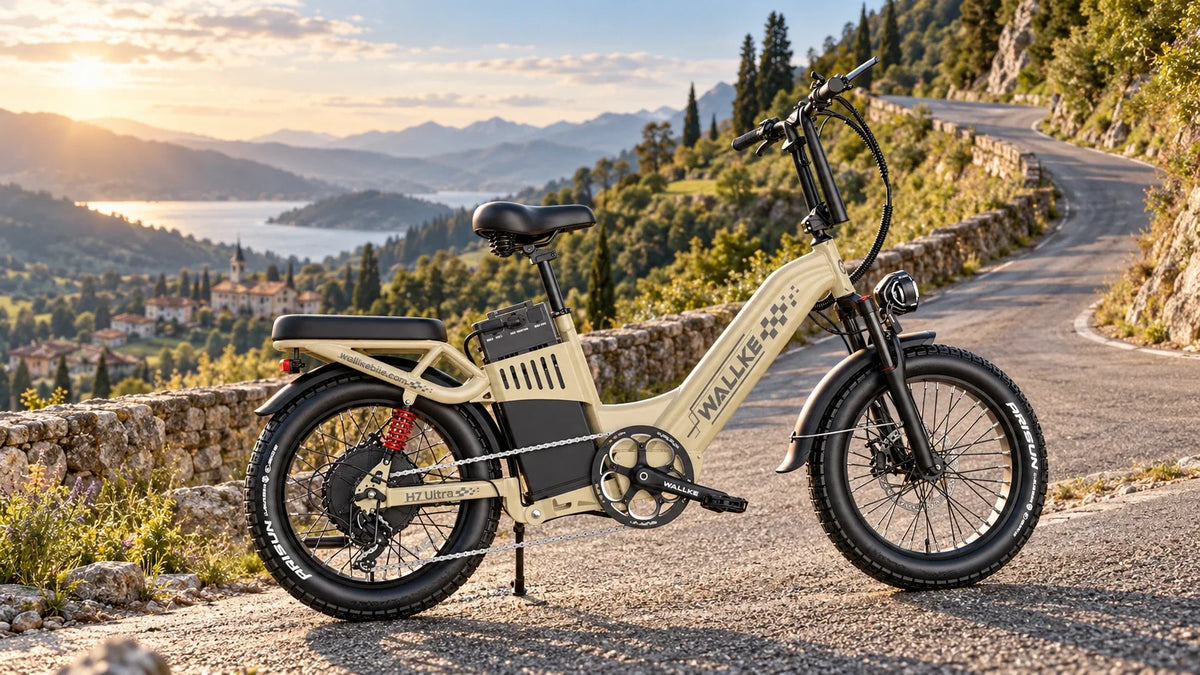
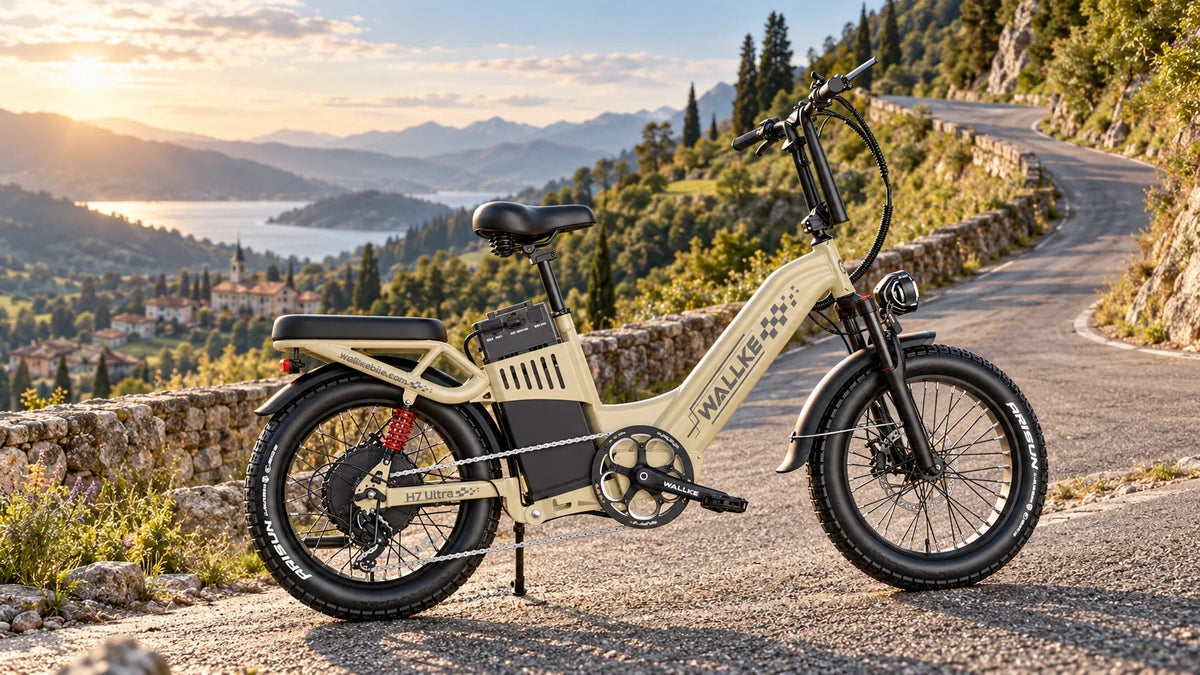
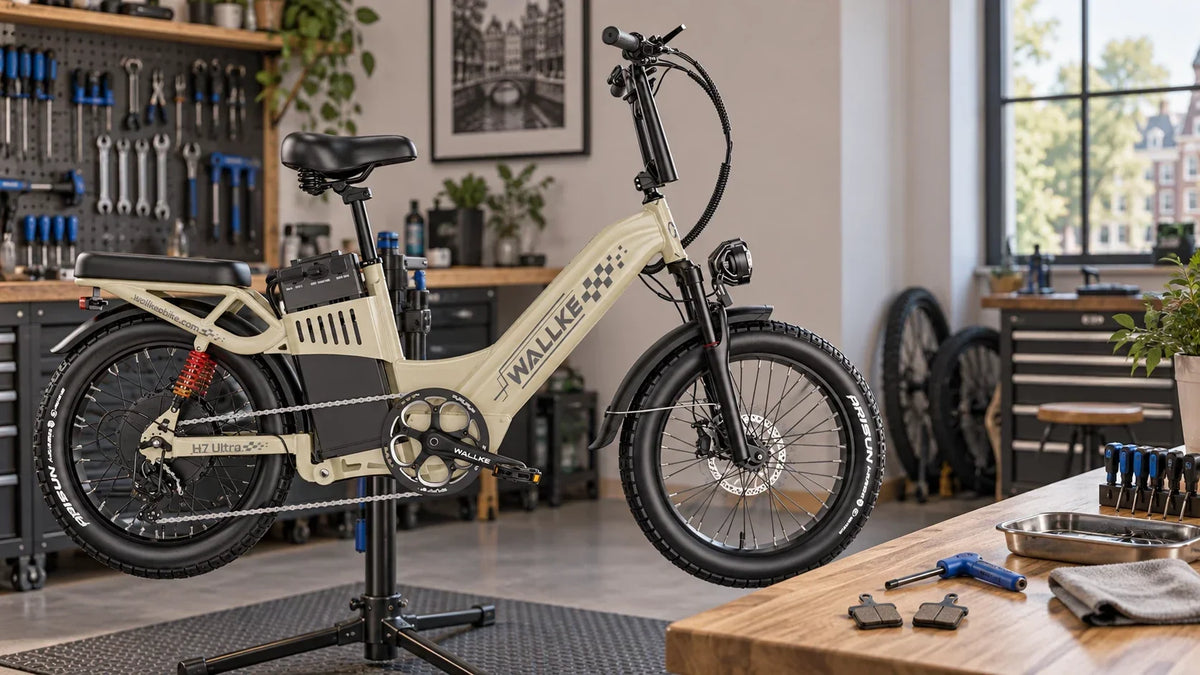
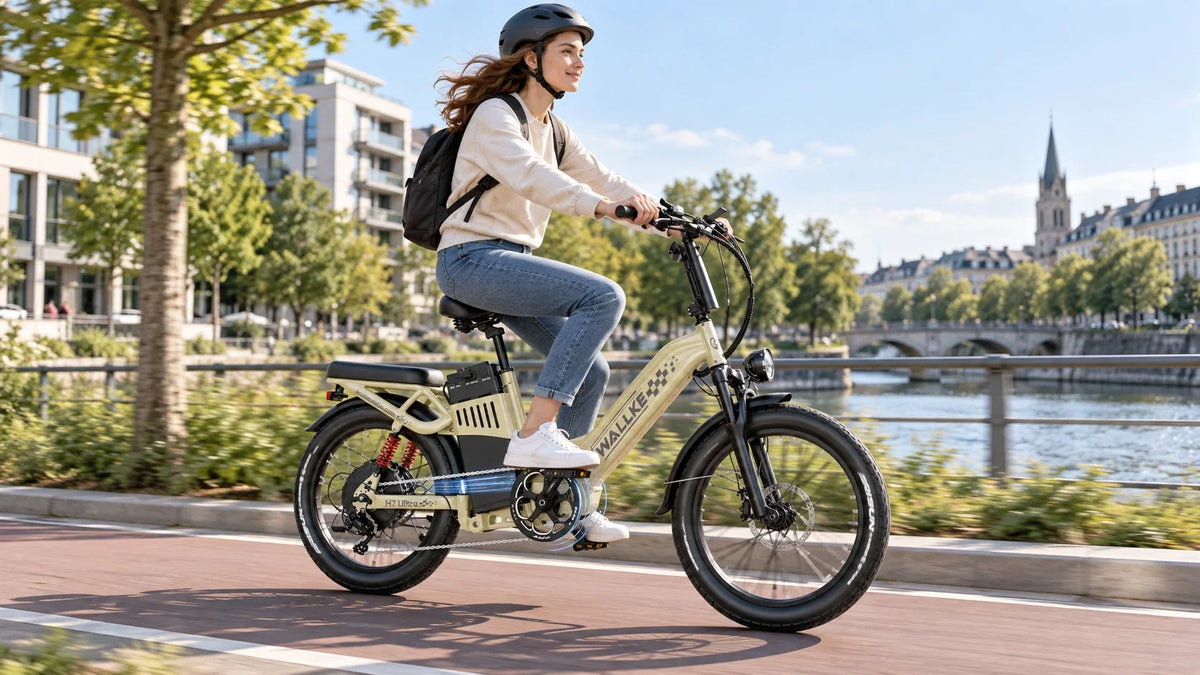
Wallke's current European range includes two 20 × 4-inch fat-tyre bikes with different approaches to frame access and storage. They are examples of what a 20-inch format can offer, not proof that this wheel size is best for everyone.
| Published specification | H7 AWD | H9 AWD |
|---|---|---|
| Frame | Step-through, non-folding | Step-over, folding |
| Tyres | 20 × 4 in | 20 × 4 in |
| Overall length | 196 cm | 194 cm |
| Standover height | 50 cm | 70 cm |
| Minimum saddle height | 88 cm | 86 cm |
| Listed rider-height range | 174–198 cm | 174–200 cm |
| Folded dimensions | Not applicable | 102 × 55 × 77 cm (L × W × H) |
These are manufacturer-listed specifications for the European-site AWD product pages checked in October 2026, not independently measured fit guarantees. Some product-page size and weight fields are inconsistent; confirm the exact current SKU before making storage or lifting decisions.
Choose the H7 AWD step-through e-bike to investigate if a lower step-through entry is important and you do not need a folding frame. Investigate the folding e-bike range and H9 AWD if reducing the bike's stored footprint is the priority.
Neither may be the right purchase if you need a very light bicycle, if the rider-height range does not suit you or if the complete bike will be difficult to lift. If you are still deciding on your overall riding style, compare the broader commuter electric bike options rather than choosing fat tyres simply because they look more substantial.
Before buying in Europe, check the legal category
Wheel size does not determine whether an electric bicycle can be used on public roads or cycle paths. The motor configuration and how assistance works matter.
Under the exclusion for conventional pedal-assist cycles in EU Regulation 168/2013, Article 2(2)(h), the auxiliary motor has a maximum continuous rated power of no more than 250 W, assistance stops when the rider stops pedalling and is progressively reduced and cut off before 25 km/h. This is a definition within that regulation, not a blanket approval of every bike advertised at 25 km/h.
Wallke's H7 AWD and H9 AWD pages list dual-motor configurations with headline 1000 W + 1000 W figures. Do not assume those configurations qualify as standard EU pedelecs simply because a product card also says 25 km/h. Ask for the actual delivered configuration, continuous rated power, assistance and throttle behaviour, and relevant conformity or vehicle-category documentation. Check the rules for the country and routes where you will ride. Requirements also differ outside the EU.
Five checks that matter more than the wheel-size label
- Fit: Compare inseam, standover, saddle-height range and reach. Test ride where possible.
- Storage: Compare full bike measurements, folding dimensions and loading access—not just wheel diameter.
- Weight: Ask for an unambiguous ready-to-ride weight for the exact battery and fitted accessories.
- Route: Choose tyre construction, tread, brakes, suspension and gearing for the surfaces you really use.
- Ownership: Confirm local legal use, replacement tyre sizes, service access, battery support and delivery conditions before paying.
If you can only test one thing, ride the bike through a normal stop, start, slow turn and a few bumps. If you cannot test ride, ask the seller for measurements and clarification in writing. A bike that looks perfect in a photograph can still be awkward in daily use.
Frequently asked questions
What is the main difference between a 20-inch and 26-inch e-bike?
The main difference is nominal wheel diameter. A larger effective wheel diameter can make obstacle rollover easier, while smaller-wheel designs can feel more responsive. The complete frame, tyres, suspension and geometry decide how either bike actually rides.
Can adults ride a 20-inch electric bike?
Yes. Many 20-inch e-bikes are designed specifically for adults. Check the recommended rider-height range, saddle adjustment, standover and handlebar reach rather than treating 20-inch wheels as a children's-bike label.
Is a 20-inch e-bike too small for a tall rider?
Not necessarily. Some adult 20-inch e-bikes accommodate tall riders. Wheel diameter does not tell you cockpit length or saddle height, so check the exact geometry and fit limits. A test ride is preferable.
What size person should ride a 26-inch bike?
There is no universal rider height for 26-inch wheels. A 26-inch e-bike can come in different frame geometries and sizes. Use the manufacturer's fit chart, inseam guidance and saddle/reach dimensions.
What age should you ride a 20-inch bike?
Wheel size alone does not determine age suitability. Adult 20-inch e-bikes and children's 20-inch bicycles are different products. Follow the specific model's age, size and safety guidance, as well as local rules.
Are 26-inch wheels good for adults?
Yes. They are a normal option for adult bicycles and e-bikes. Whether they suit you depends on frame fit, tyre type, terrain and your storage needs.
Are 20-inch e-bikes easier to store or carry?
Not always. Smaller wheels do not guarantee a shorter frame or a lighter bike. Check total length, folding design, folded measurements, and ready-to-ride weight before buying.
Do 26-inch e-bikes have better range or speed?
Not automatically. Range and speed depend on the specific motor, assistance limits, battery, gearing, tyres, terrain and load. Wheel size on its own does not establish either result.
Which is better: 20 × 4.0 or 26 × 4.0 fat tyres?
Neither wins for every rider. A 26 × 4.0 design may help with rolling over rougher surfaces, while a 20 × 4.0 bike may suit a preferred frame or folding format. Check fit, tyre pressure limits, suspension, complete dimensions and local legal use.
Final verdict
For a 20 vs 26 inch ebike decision, the best question is not “Which wheel is better?” It is “Which complete bike will work on my route, fit my body and fit my home?”
Start with 20-inch models if a particular adult frame design appeals to you. Explore 26-inch models if you want a larger-wheel riding feel, especially over repeated rough patches. Then check the actual dimensions, weight, components and legal category. If those do not work, move on—even when the wheel size looks ideal.
Leave a comment