



Pedal assist is the system that makes an electric bike feel easier to ride while you are still turning the pedals.
A sensor detects what the rider is doing. The controller interprets that signal. The motor then adds support according to the selected assist setting.
If you are comparing electric bikes for adults, pedal assist is worth understanding before you focus on battery size or headline motor figures. It affects how the bike starts, climbs, behaves at low speed and responds to your legs on every ride.
What Does Pedal Assist Mean on an Electric Bike?
Pedal assist, often shortened to PAS, is a control system that provides electric motor assistance while the rider pedals.
It is not a separate category of bicycle in itself. It is one way an e-bike can decide when and how to use its motor.
Many electric bikes use pedal assist as their main form of motor assistance. Some models also include other control functions, depending on the bike's configuration and local rules.
Pedal assist should also not be confused with an automatic cruise function. The motor is responding to inputs from the rider and the bike's control system. It is not simply trying to maintain a fixed road speed.
How Does Pedal Assist Work?
A modern pedal-assist system usually involves four main parts:
- battery
- motor
- controller
- one or more sensors
The display or handlebar control lets the rider choose an assistance level.
The basic process works like this:
- You start pedalling. A cadence sensor may detect crank movement, while a torque sensor measures pedal force. Some systems combine several inputs.
- The sensor sends a signal. The controller receives information about your pedalling and may also use vehicle speed and other safety inputs.
- The controller applies the assist setting. It decides how much motor support to request within the system's programmed limits.
- The motor adds power. The assistance joins your own effort rather than replacing the pedals.
- Assistance changes or stops. It can reduce when you select a lower level, stop pedalling, reach the system's assistance cut-off, or trigger another relevant cut-off input.
The sensor does not work alone. Two e-bikes with the same broad sensor type can feel very different because their controllers, power ramps, gearing and motor response are tuned differently.
For a deeper look at one common system, see Wallke's guide to how a cadence pedal sensor works on an e-bike.
What Does a Pedal-Assist Level Actually Control?
Selecting “Level 3” does not have one universal meaning across every e-bike.
Depending on the system, an assist level can change:
- the amount of current available to the motor;
- the target support curve;
- how strongly the motor responds to rider input;
- or a combination of these.
Manufacturers can tune their systems differently. A higher level usually means more assistance, but it does not necessarily mean the bike is trying to maintain a particular speed or deliver one fixed number of watts.
| Setting | What you may feel | Typical reason to use it |
|---|---|---|
| Assist off / Level 0 | No normal motor assistance while pedalling | Riding like a conventional bicycle or conserving battery |
| Low assist | Light support with more rider contribution | Flat roads, exercise and extending range |
| Medium assist | More noticeable help | Everyday commuting and mixed routes |
| High assist | Stronger motor contribution | Hills, headwinds, heavier loads or reducing rider effort |
Exact behaviour is model-specific. The number of assist levels alone does not tell you how smoothly or strongly an e-bike will respond.
Cadence Sensor vs Torque Sensor: Why the Bike Feels Different
The sensor is one of the biggest influences on pedal-assist feel.
| Feature | Cadence sensor | Torque sensor |
|---|---|---|
| Main input | Crank movement or pedalling rate | Pedal force or drivetrain strain |
| Typical feel | Often more level-driven; exact response depends on cadence logic and controller tuning | Support usually rises and falls more directly with rider effort |
| Rider effort | Can provide strong help with light pedal pressure, depending on tuning | Usually asks the rider to push to request more support |
| Low-speed control | Depends heavily on start delay and controller tuning | Often easier to modulate through pedal pressure |
| Often suits riders who prefer | Low-effort riding and simple level-based support | A more natural bicycle feel and proportional control |
Neither sensor is automatically “better”.
A well-tuned cadence system can be smooth. A poorly calibrated torque system can still feel disappointing.
The right choice depends on how much physical input you want to provide and how precisely you want the bike to follow that input.
If this is an important buying decision, read Wallke's full torque sensor vs cadence sensor comparison rather than choosing from the sensor name alone.
Pedal Assist vs Throttle: What Is the Difference?
Pedal assist and throttle control are two different ways of requesting motor power.
With normal pedal assist, the rider pedals and the system adds support.
A throttle can request motor power through a hand control, depending on how the bike is designed and configured.
| Question | Pedal assist | Throttle |
|---|---|---|
| Do you normally need to pedal for propulsion assistance? | Yes | Not necessarily |
| How is assistance requested? | Pedalling input plus selected assist level | Hand control |
| Ride feel | Closer to cycling with extra support | Can provide propulsion without normal pedalling |
| Legal treatment | Depends on complete vehicle configuration | Can change the vehicle's legal classification |
Some e-bikes are designed with both systems. Whether both functions can be used, how they interact and where they are legal depends on the exact bike and local law.
For European riders, do not assume the US “Class 1, Class 2 and Class 3” system applies where you live.
Does Pedal Assist Drain the Battery?
Yes. Whenever the motor provides assistance, it uses energy from the battery.
The more useful question is how quickly.
Higher assistance generally asks the motor to do more work. Real-world energy consumption is also affected by:
- hills;
- wind;
- riding speed;
- rider and cargo weight;
- tyre pressure;
- temperature;
- stop-start riding;
- motor configuration;
- how much work the rider contributes.
A torque sensor does not automatically guarantee better range. A cadence sensor does not automatically waste energy.
The rider, controller tuning and complete bike matter more than the sensor label by itself.
If range matters, compare stored battery energy and realistic riding conditions rather than relying on one advertised distance.
Voltage is not a range figure on its own either. Two 48V e-bikes can have very different battery capacities and real-world ranges. If you are comparing this voltage class, see Wallke's 48V electric bikes while still checking battery capacity and the exact riding conditions behind any range figure.
Do Pedal-Assist Bikes Charge When You Pedal?
Normally, no.
Pedal assist uses battery energy to help the rider. Ordinary pedalling does not usually recharge the battery.
A small number of electric drive systems can recover energy under specific conditions, but regenerative charging is a separate feature. It should not be assumed simply because a bicycle has pedal assist.
How Much Effort Does a Pedal-Assist E-Bike Require?
There is no single answer.
A low assist setting can leave most of the work to the rider. A strong assist setting can make the same route much easier.
Sensor type matters as well. A cadence-based system can often provide substantial help as long as the pedals are turning. A torque-based system usually responds more directly to how hard you push.
You still need to use the gears.
Starting a steep hill in a very high gear can put unnecessary strain on the rider and drivetrain even if the motor is helping. Shift before the gradient becomes difficult and aim for a comfortable, sustainable pedalling rhythm.
For commuting, that flexibility is one reason riders consider commuter electric bikes. You can use more assistance when arriving fresh matters, then reduce support when you want more exercise.
Can You Turn Pedal Assist Off and Ride Normally?
On many e-bikes, yes.
You can select an assist-off setting or switch the electrical system off and continue pedalling.
There is one practical catch: an e-bike can be much heavier than a conventional bicycle.
Wide tyres, suspension, larger batteries and robust frames can make unassisted riding noticeably harder, particularly on hills.
If you expect to ride without motor assistance regularly, total bike weight and gearing deserve as much attention as the motor system.
What If Pedal Assist Stops Working?
Do not immediately assume the motor has failed.
Start with simple, non-invasive checks:
- Confirm the display is on.
- Check that an assist level above zero is selected.
- Make sure the battery is charged and correctly seated.
- Inspect visible sensor and cable connections for obvious looseness or damage.
- Check that a brake cut-off is not being held active.
- Look at the model manual for sensor alignment or error-code guidance.
Avoid opening the battery, controller or other sealed electrical components unless the manufacturer specifically instructs you to do so and you are qualified to perform the work.
If the battery itself will not charge, use a dedicated process instead. Wallke has a separate e-bike battery charging troubleshooting guide for that problem.
Is Pedal Assist Legal in Europe?
Pedal-assist e-bikes can fall into different legal categories in Europe, depending on motor rating, assistance behaviour, speed and national rules.
“Europe” is not one single e-bike rulebook. It is better to separate the EU framework from individual national road-use rules.
Within the European Union, Regulation (EU) No 168/2013 contains the familiar exemption for pedal cycles with pedal assistance where:
- the auxiliary electric motor has a maximum continuous rated power of no more than 250 W;
- motor output cuts when the cyclist stops pedalling;
- assistance is progressively reduced;
- and assistance is finally cut off before the vehicle reaches 25 km/h.
That does not mean every product described as an “e-bike” or “pedal assist bike” automatically falls into that category.
Motor rating, assistance behaviour, speed settings, throttle configuration and national rules can affect how a vehicle may be used.
Outside the EU, do not assume Regulation (EU) No 168/2013 applies in the same way. Check the rules and vehicle classification used in the country where you plan to ride.
For European buyers, always check the exact supplied configuration for your country. Do not use US Class 1, Class 2 or Class 3 labels as a substitute for local European requirements.
How to Choose a Pedal-Assist Electric Bike
Do not choose an e-bike from the number of assist levels alone.
Start with the riding problem you actually need to solve.
1. Decide How You Want the Assistance to Feel
If you want the motor to follow your physical effort closely, test a torque-sensing system.
If you want substantial help with relatively light pedal pressure, a well-tuned cadence system may suit you better.
2. Test the First Pedal Stroke
Pull away slowly in a low gear.
Pay attention to:
- delay before assistance starts;
- sudden surging;
- how smoothly power arrives;
- how quickly assistance ends when you stop pedalling;
- low-speed control.
These details matter more in daily riding than the sensor name on a specification sheet.
3. Check the Bike, Not Only the PAS
Compare:
- gearing;
- brakes;
- battery capacity;
- tyre type;
- total weight;
- rider fit;
- intended terrain;
- storage requirements.
Pedal assist cannot compensate for a bike that is too heavy for your storage situation or uncomfortable for your body size.
If storage matters, compare folding e-bikes.
If your routes regularly include gravel and rough surfaces, compare the trade-offs of fat tyre e-bikes as well.
4. Compare Realistic Range
Ask what conditions were used for any range claim.
High assistance, hills, cold weather, heavier loads and higher speeds can reduce riding distance substantially compared with ideal test conditions.
5. Confirm the Exact Sensor and Configuration
Product families can change between model years and variants.
Check the current specification table and manual for the exact bicycle you plan to buy.
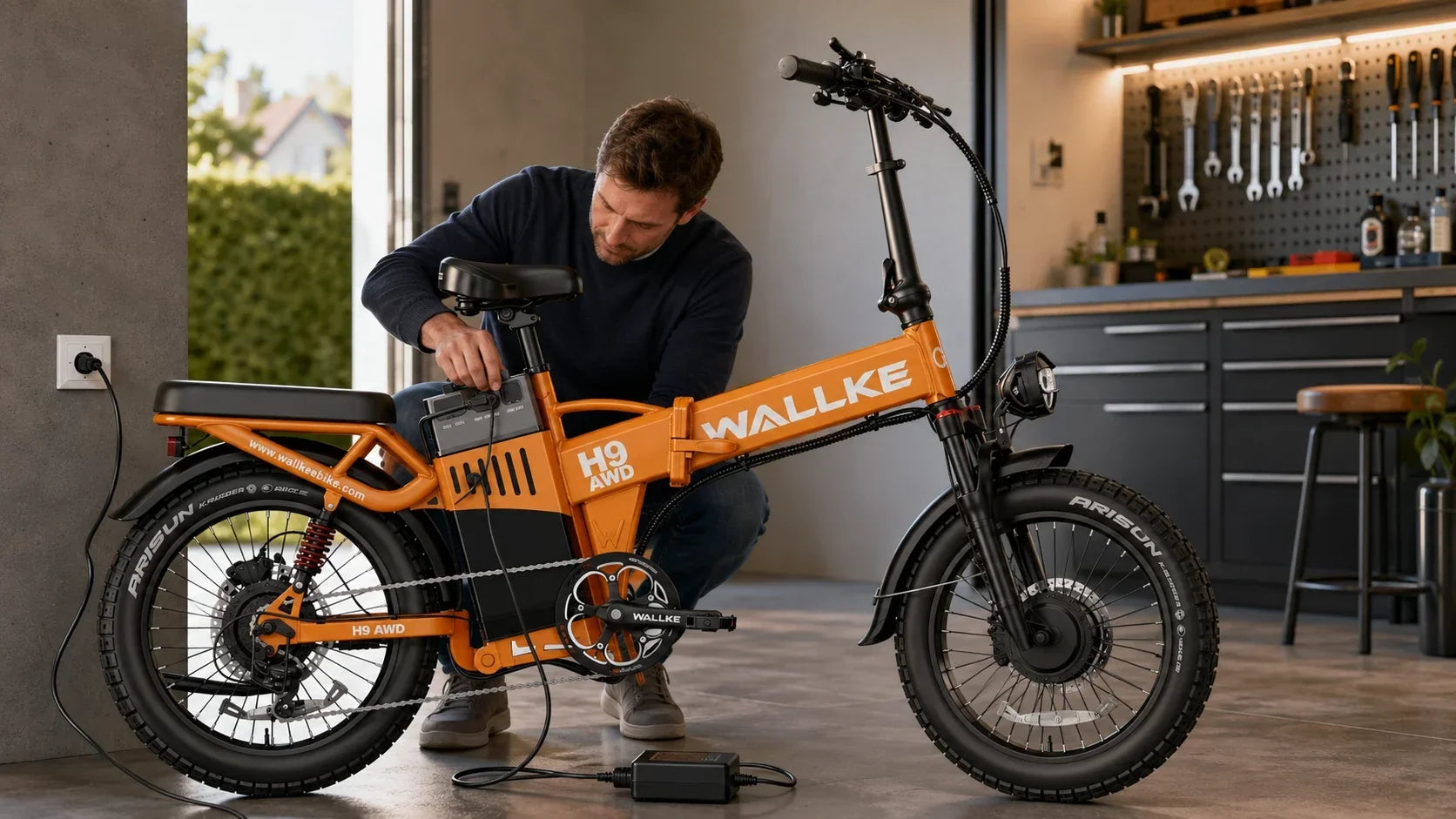
At the time this guide was prepared, the published specifications for the Wallke H7 Step-thru and Wallke H9 AWD listed cadence sensors.
That tells you the broad PAS type. It does not tell you everything about ride quality. Controller tuning, gearing, bike weight and the complete drive setup still determine how the assistance feels.
Pedal Assist: The Practical Takeaway
Pedal assist is best understood as a control system, not a promise of a particular speed, effort level or range.
The sensor detects rider input. The controller decides how to respond. The motor adds support within the bike's programmed limits.
For a buyer, the most useful questions are simple:
- How quickly does assistance start?
- How smoothly does it stop?
- How much effort do I want to contribute?
- Can I control the bike comfortably at low speed?
- Does the exact configuration fit the rules where I ride?
Answer those questions first. Then compare the wider Wallke electric bike range by frame, battery, weight, terrain and storage needs.
Frequently Asked Questions
What is pedal assist on an e-bike?
Pedal assist is a system that uses sensors, a controller and an electric motor to add power while the rider pedals. The amount and feel of the assistance depend on the selected level and the bike's control system.
How does pedal assist work?
A sensor detects pedalling input and sends it to the controller. The controller combines that signal with the selected assist level and other system inputs, then tells the motor how much support to provide.
Does pedal assist use more battery at higher levels?
Usually, higher assistance asks the motor to do more work and therefore uses battery energy faster. Actual range also depends on hills, speed, wind, temperature, tyre pressure, total weight and rider contribution.
Can you turn pedal assist off on an e-bike?
Many e-bikes allow an assist-off setting or can be ridden with the electrical system switched off. The bike may feel harder to pedal than a normal bicycle because e-bikes are often heavier.
Which is better, a cadence sensor or a torque sensor?
Neither is universally better. Cadence sensors can suit riders who want strong support with light pedal pressure, while torque sensors usually provide assistance that more closely follows rider effort.
Is pedal assist legal in Europe?
Rules depend on the country and the complete vehicle configuration. In the EU, the familiar pedal-cycle exemption includes a maximum continuous rated motor power of 250 W, assistance that stops when pedalling stops, and assistance that is progressively reduced and cut off before 25 km/h. Outside the EU, do not assume the same framework applies in the same way.
Leave a comment