



Looking for a folding eBike for steep hills is harder than shopping for a normal folding bike. You are asking one bike to do two jobs that often pull in opposite directions: fold small enough to store or transport, yet remain stable, controllable and strong enough for repeated climbing.
If folding is essential, start with the terrain rather than the hinge. Compare the current Wallke folding eBikes, but judge any model by its complete climbing setup: motor system, gearing, wheel size, traction, battery, bike weight and brakes.
Not sure whether a folding bike is the right starting point? See our broader guide to choosing the best electric bike for hills by terrain, motor type, gearing, traction and riding style.
- What actually determines hill-climbing performance
- Mid-drive vs rear hub vs AWD
- Lightweight folding eBike vs strong hill climber
- How to read torque, wattage and climbing-angle claims
- How to ride a folding eBike uphill
- A current Wallke example
- European road-use considerations
- Buying checklist
- Frequently asked questions
Editorial note: This article is a buying guide, not a controlled laboratory hill test. Published motor, torque, battery and range figures come from manufacturers and are not always measured under the same protocol. Real climbing performance changes with gradient, surface, rider mass, cargo, tyre pressure, temperature, state of charge and climb duration.
What Makes a Folding eBike Good for Steep Hills?
A steep climb asks much more from an e-bike than flat commuting. The motor has to produce useful force at low speed while the battery supplies high current. At the same time, the rider still needs enough traction and gearing to keep the bike moving smoothly.
The best folding e-bike for steep hills is therefore not automatically the model with the biggest power number.
1. Motor layout matters as much as motor power
A motor's position changes how its power reaches the road.
- Mid-drive: drives through the bicycle drivetrain, so the motor can benefit from the bike's lower gears. This can be useful on sustained climbs.
- Rear hub: delivers power directly at the rear wheel. It can work well for urban hills and mixed riding, but a long, slow climb can be more demanding on the motor.
- Dual-motor or AWD: powers both wheels on some designs. It can add traction and drive force, particularly on loose surfaces or under heavier loads, but usually adds weight, complexity and energy consumption.
If rough tracks are part of your route, the broader Wallke off-road e-bike buying guide explains why motor position, gearing, tyres and total mass need to be considered together.
2. Torque is useful, but the Nm number is not a universal score
Torque is the turning force produced by the drive system. More usable torque can make starting on a hill easier and reduce the feeling that the motor is struggling at low speed.
However, two bikes with the same advertised torque can feel very different. Hub motors and mid-drives apply force through different paths. Wheel diameter, gearing, controller tuning and the way the figure was measured can all change the result.
Do not buy from a single Nm number. Use torque as one part of the comparison.
3. Low gearing is one of the most overlooked hill features
Many riders focus on motor wattage and forget the mechanical gears.
A suitably low gear lets you keep the cranks turning when road speed falls. This is especially important with a mid-drive because the motor can use the bicycle's gearing. It still matters on hub-motor bikes because your own pedalling helps reduce motor load and battery consumption.
Before buying, ask:
- Does the bike have a genuinely low climbing gear?
- Can you shift into that gear before the gradient becomes severe?
- Can you restart on a slope without immediately overloading the drivetrain?
4. Wheel size and tyre grip affect what happens at the road
Many foldable electric bikes for adults use smaller wheels because they reduce the folded package. Smaller wheels also change effective wheel torque and handling.
Tyres matter just as much. A wider tyre can add grip and stability on gravel, broken surfaces and loose climbs, but it also adds weight and rolling resistance. If you regularly ride mixed surfaces, compare fat tyre eBikes as well as lightweight folders.
For a paved city hill, a heavy fat tyre may be unnecessary. For rough climbs, a narrow, ultra-light commuter tyre may not give you the traction you want.
5. Battery capacity affects repeatable climbing, not just range
Hill climbing uses more energy than steady riding on flat ground. A large battery does not create climbing torque by itself, but it gives the system more stored energy for repeated climbs and longer routes.
Compare battery energy in watt-hours rather than looking only at voltage. Two 48V bikes can have very different battery capacities. Wallke's 48V electric bike collection explains this distinction in more detail.
Cold weather, a low state of charge, high assistance levels, heavy loads and repeated steep ascents can all reduce practical range.
6. Total system weight changes the climb
This is where the phrase “folding e-bike” can mislead buyers.
A bike can fold and still be extremely heavy. Large batteries, dual motors, suspension, wide tyres and reinforced frames all add mass. That weight has to be moved uphill, lifted into a car and controlled on the way back down.
Always add together:
- bike weight;
- rider weight;
- battery and accessories;
- bags, locks and cargo.
If you need to carry the bike upstairs every day, a powerful folding fat-tyre model may solve the hill problem while creating a new transport problem.
7. Brakes matter just as much as climbing performance
Every steep climb eventually becomes a steep descent.
That means brake type, rotor size, pad condition, tyre grip and total mass are part of the hill-climbing buying decision. A bike that climbs confidently but overheats its brakes or feels difficult to control downhill is not well matched to a hilly route.
Mid-Drive vs Rear Hub vs AWD for Steep Hills
| Drive system | Where it can work well | Main strengths | Trade-offs |
|---|---|---|---|
| Mid-drive | Long climbs, technical riding, routes where low gearing matters | Can use the bicycle's gears; balanced central weight on many designs | More drivetrain wear; often more expensive; less common on compact folding bikes |
| Rear hub | Urban hills, commuting, moderate mixed terrain | Simple layout; independent of bicycle gears for motor drive | Long slow climbs can create more heat; rear wheel can be heavier to service |
| Dual-motor / AWD | Loose surfaces, heavy loads, traction-limited climbs | Drive at both wheels on compatible systems; strong acceleration and extra traction | Heavier; greater battery demand; more components; legal classification must be checked carefully |
There is no universal winner. If you want a compact commuter for a paved 10-minute climb, your priorities may be very different from someone riding gravel access roads with cargo.
Lightweight Folding Electric Bike or Strong Hill Climber?
Searches for a lightweight folding electric bike for adults often overlap with searches for the best folding e-bike for steep hills. In practice, those goals can conflict.
| Priority | What usually helps | What you may give up |
|---|---|---|
| Easy carrying | Smaller battery, single motor, narrow tyres, simpler frame | Range, traction, suspension and sustained high-load performance |
| Steep-hill capability | Useful torque, low gearing, stronger brakes, larger battery, suitable tyres | Low weight and very small folded dimensions |
| Rough terrain | Grip, suspension, robust wheels and tyres | Compactness, rolling efficiency and carrying convenience |
If you regularly lift the bike onto a train or carry it to a third-floor flat, set a maximum bike weight before you compare motors. If you mainly fold the bike to fit inside a car, motor and battery capability may matter more than carry weight.
How to Read Wattage, Torque and “Climbing Angle” Claims
Hill-performance marketing is full of numbers that look precise but are difficult to compare.
Do not confuse hill grade with degrees
Road signs normally describe gradient as a percentage. Product pages sometimes use degrees. These are not the same measurement.
Before comparing two claimed climbing figures, check whether both use the same unit and whether the test conditions are stated.
Do not assume peak wattage predicts climbing
Peak power describes a short-term output claim. It does not tell you how long the system can sustain that output on a slow climb.
For real-world hills, ask about:
- continuous or rated motor output;
- motor torque and where it is measured;
- low-speed gearing;
- controller limits;
- thermal protection;
- test rider and cargo mass;
- surface and tyre setup;
- climb length, not only the steepest short section.
Be cautious with one-number hill claims
A short dry ramp with a light rider is very different from a 15-minute climb in hot weather with luggage. A claimed maximum climbing angle can be useful as manufacturer information, but it should not replace a complete comparison.
Cadence Sensor or Torque Sensor for Hills?
A torque sensor responds to how hard you push the pedals. A cadence sensor mainly detects crank movement or pedalling rate, depending on the system.
A torque-sensing bike can feel easier to modulate when traction is limited because assistance often follows rider effort more closely. A well-tuned cadence system can still climb effectively and may suit riders who want strong support without pressing hard on the pedals.
Neither label guarantees a better hill bike. Controller tuning, gearing and motor response matter. For a deeper explanation, read Wallke's guide to the cadence pedal sensor and the guide to pedal assist.
How to Ride a Folding eBike Up a Steep Hill
Technique can make a capable bike climb better and reduce unnecessary stress on the motor and drivetrain.
- Shift early. Select a lower gear before cadence collapses.
- Keep pedalling. Your own input reduces the work demanded from the motor.
- Build a little momentum where safe. Starting a climb at walking speed is harder than entering it smoothly.
- Stay seated when traction is limited. On loose ground, keeping weight over the driven wheel can help prevent spin. Adjust body position for the bike and terrain.
- Avoid unnecessary full-power bursts. Smooth assistance can be easier on traction and the drivetrain.
- Watch motor behaviour. If the system repeatedly cuts power, shows an error or becomes abnormally hot, stop and let it cool rather than forcing the climb.
- Plan the descent. Check brakes before a hilly ride and avoid dragging one brake continuously on a long descent.
If the bike cannot restart safely on the steepest section of your normal route, that matters more than a headline top-speed figure.
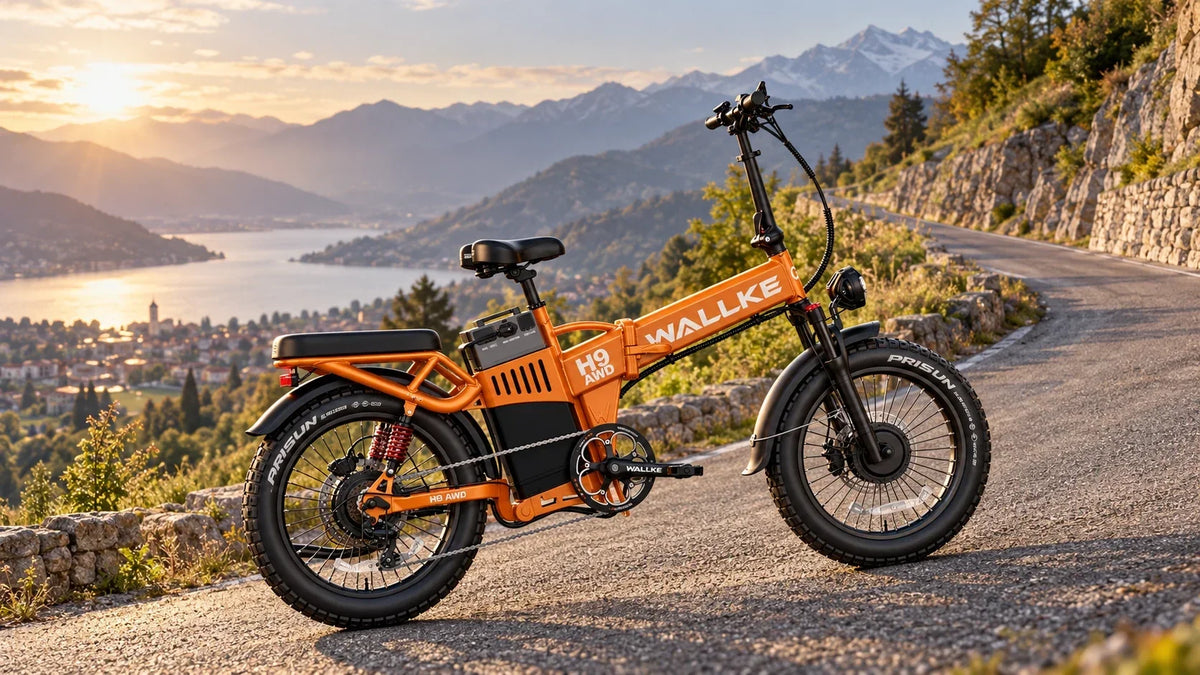
A Current Wallke Folding Example: H9 AWD
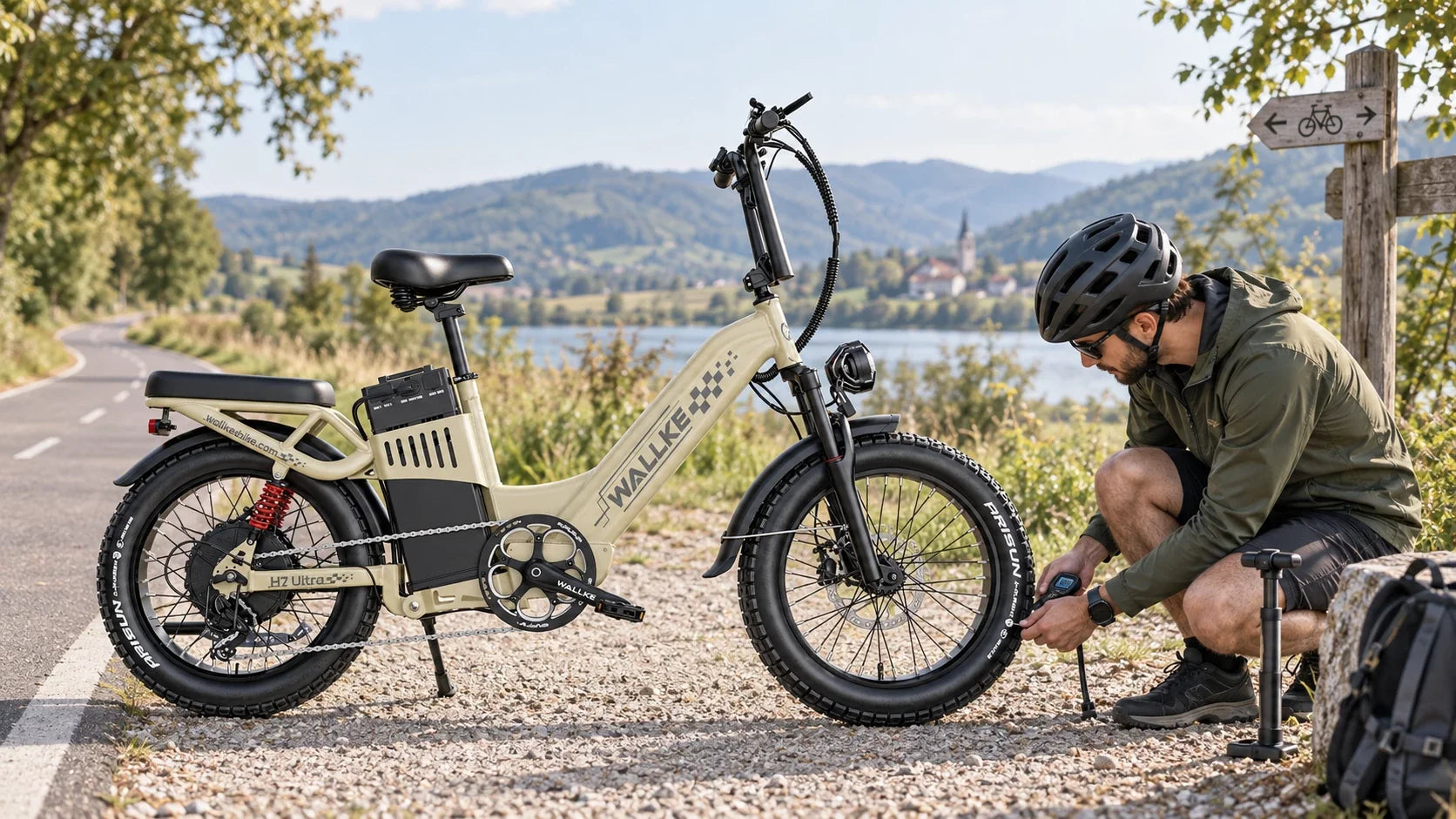
Wallke's current European folding range includes the H9 AWD. It is a useful example of a capability-first folding e-bike rather than a lightweight city folder.
The current product page lists:
- folding step-over frame;
- dual-motor AWD configuration;
- 20 × 4 inch fat tyres;
- full suspension;
- hydraulic brakes;
- 48V 40Ah / 1,920Wh battery on the listed EU configuration;
- 60.3 kg published net weight.
Those specifications illustrate the central trade-off in this article. The H9 AWD is designed around traction, battery capacity, rough-surface capability and folding storage. It is not a lightweight folding e-bike that most people will want to carry up several flights of stairs.
If easier mounting matters more than folding, compare it with Wallke's current electric bike range or use the e-bike comparison page.
Can You Use a Powerful Folding eBike on Public Roads in Europe?
Europe does not have one single road-use rule for every e-bike.
Within the EU, the familiar ordinary pedal-assisted-cycle exclusion is built around a maximum continuous rated auxiliary motor power of no more than 250W, assistance that stops when the rider stops pedalling, and assistance that is progressively reduced and cut off before 25 km/h.
A bike above that ordinary EPAC framework is not automatically “illegal”, but it may fall into another vehicle category with different approval, registration, insurance, helmet or road-access requirements.
This matters when you are comparing a 750W folding e-bike, a dual-motor model or an AWD e-bike. Read the full Wallke guide to electric bike laws in Europe and check the exact rules for your country before public-road use.
What About a DIY Folding eBike for Hills?
A DIY folding eBike conversion can look attractive because you can choose the motor and battery yourself. The folding frame makes compatibility more complicated.
Before converting a folder, check:
- whether the frame and fork are approved for the extra motor and battery loads;
- whether motor torque could overstress dropouts or hardware;
- whether cables can move safely when the bike folds;
- whether the battery is securely mounted without interfering with the hinge;
- whether brakes are adequate for the new total mass and speed capability;
- whether the conversion changes the vehicle's legal classification.
Do not drill, cut or modify a folding hinge to make a conversion fit unless the frame manufacturer specifically supports that modification. The hinge is a structural part of the bicycle.
Buying Checklist: Best Folding eBike for Steep Hills
Use this checklist before buying any folding hill bike:
- Measure your real hill. Know whether it is a short ramp or a long sustained climb.
- Check total load. Rider, bike, lock, luggage and cargo all count.
- Compare drive system. Mid-drive, rear hub and AWD solve the problem differently.
- Check low gearing. Do not rely on motor power alone.
- Look at usable torque, not only peak watts.
- Check tyres and surface. Paved roads, gravel and loose tracks need different priorities.
- Compare battery Wh. Repeated climbing can consume energy quickly.
- Check bike weight and folded size. Folding does not mean lightweight.
- Check brakes. A hill bike also has to descend safely.
- Test low-speed control. Try starts, tight turns and a restart on a slope if a test ride is available.
- Verify public-road classification. Especially for 500W, 750W, 1000W or dual-motor configurations.
- Check serviceability. Brake pads, tyres, tubes, batteries and electronic parts should be obtainable where you ride.
So, What Is the Best Foldable Electric Bike for Hills?
There is no single best model for every steep route.
If your priority is maximum portability, choose the lightest bike that can still handle your gradient, rider weight and route length. If your priority is repeated steep climbing, accept that a larger battery, stronger brakes, wider tyres or a more capable drive system may make the bike heavier.
For rough or traction-limited climbs, an AWD folding bike can be worth considering. For long technical climbs, a properly geared mid-drive is also a strong option. For normal paved hills, a simpler rear-hub folder may be enough.
The correct choice starts with the hill you actually ride, not the biggest number on the product page.
Frequently Asked Questions
Can a 750W folding eBike climb steep hills?
It can, but 750W alone is not enough to predict climbing performance. Torque, wheel size, gearing, rider and cargo weight, controller tuning, climb length, traction and motor cooling all matter. In Europe, also check the vehicle classification: if 750W is the maximum continuous rated motor power, it does not fit the ordinary 250W EU EPAC exclusion.
Can electric bikes go up steep hills?
Yes, many can. The steeper and longer the climb, the more important low gearing, usable torque, rider input, battery condition, traction and thermal management become. A short steep ramp is also a different challenge from a long sustained climb.
What is the best foldable electric bike for hills?
The best choice is the one that matches your real gradient, total load, surface and storage needs. Prioritise low-speed control, suitable gearing, useful torque, reliable brakes, enough battery capacity and manageable bike weight rather than choosing by peak wattage alone.
Is a mid-drive better than a hub motor for steep hills?
A mid-drive can be very effective on steep climbs because it can use the bicycle's lower gears. A hub motor can still climb well, especially on shorter urban hills. AWD or dual-hub systems can add traction and drive force but usually increase weight and battery use.
Are lightweight folding eBikes good for steep hills?
Some are, but lightweight design usually means compromises in battery size, motor system, suspension or tyre size. If you need to carry the bike frequently, weight may be more important than maximum climbing capability. If you rarely carry it, a heavier folding model may suit steep terrain better.
Do fat tyres help an eBike climb hills?
Fat tyres can add traction and stability on loose or uneven surfaces. They do not automatically make a bike climb better on every hill. On smooth pavement they also add weight and rolling resistance, so tyre choice should match the surface you actually ride.
Is a powerful folding eBike road legal in Europe?
That depends on the exact configuration and country. In the EU, the ordinary pedal-assisted-cycle exclusion uses a maximum continuous rated auxiliary motor power of 250W, assistance linked to pedalling and assistance cut off before 25 km/h. Higher-powered vehicles may require another approval category and different road-use requirements.
Leave a comment