



If you live in a hilly city or your regular route includes steep climbs, the most useful question is not “Which e-bike has the biggest motor?” It is “Which setup will keep climbing predictably on my actual route?” Motor type matters, but so do gearing, traction, battery reserve, total weight, brakes and the length of the hill.
Quick answer: For long paved climbs, a well-geared mid-drive is often a strong starting point because it can use the bicycle’s gears. For loose surfaces, steep starts or heavier mixed-terrain riding, AWD can help when traction is the main limitation. For a hilly city commute, low-speed control, brakes, battery reserve, manageable weight and a road-appropriate configuration can matter more than headline wattage.
If you are still comparing bike types, start with Wallke electric bikes for adults. If you already know you are considering two-wheel drive, the more focused AWD e-bike for hills guide explains where AWD helps and where a mid-drive may be the better answer.
Start With the Hill, Not the Motor
A short steep ramp and a long mountain road are different engineering problems. A bike that feels powerful for 30 seconds may not be the best choice for a sustained climb.
Before comparing e-bikes, write down five things about your route:
- Gradient: How steep is the hardest section?
- Climb length: Is it a 100-metre ramp or several kilometres uphill?
- Surface: Smooth tarmac, broken road, gravel, mud, snow or mixed?
- Stops: Do you need to stop and restart on the slope?
- Total load: Rider, clothing, locks, panniers, child seat or cargo.
Gradient is usually more useful when expressed as a percentage. A 10% gradient means roughly 10 metres of vertical rise for every 100 metres of horizontal distance. Do not confuse a percentage grade with degrees.
This route-first approach also reflects what riders repeatedly ask in online discussions: not whether a bike looks powerful on paper, but what actually works for a hilly commute or a genuinely steep climb.
Which Type of Electric Bike Is Best for Hills?
There is no universal winner. The motor architecture changes how the bike uses power, but each layout has trade-offs.
| Motor setup | Where it can work well | Main advantage on hills | Trade-offs |
|---|---|---|---|
| Mid-drive | Long paved climbs, mountain roads, e-MTB use | Can use the bicycle’s gears to keep the motor in a useful operating range | More load through the chain, cassette and derailleur; shifting technique matters |
| Rear hub | Moderate hills, commuting, simpler everyday systems | Drives the rear wheel independently of the bicycle drivetrain, so motor assistance does not depend on shifting through the bike’s gears. | Does not use the bike’s gears to multiply motor torque in the same way as a mid-drive |
| Dual-motor / AWD | Loose gravel, slippery surfaces, steep starts, heavier mixed-terrain setups | Drive is available at both wheels, which can help when traction is the limiting factor | More weight, more electrical demand and more components to service |
For a paved climb where wheelspin is not a problem, AWD is not automatically the best electric bike for hill climbing. A lighter mid-drive with useful low gearing may be more efficient and easier to live with.
For loose gravel, wet tracks or a loaded bike starting on a steep slope, two-wheel drive can become more relevant because the problem is not only motor output. It is whether the tyres can transfer that output to the ground.
What Actually Makes an E-Bike Good at Climbing?
1. Torque matters, but the number needs context
Torque describes twisting force. It is often shown in newton-metres (Nm), but the largest number on a product page does not automatically mean the strongest real-world climber.
Motor location, wheel size, gearing, controller limits, speed and how the torque figure was measured all affect what you feel at the tyre. Mid-drive motor torque and hub-motor torque are also not always an apples-to-apples comparison because a mid-drive can use the bicycle’s gearing.
Use torque as one part of the comparison, not as a ranking system.
2. Low gearing can matter more than another headline power figure
A steep hill forces the bike to work at low speed. Good low gearing helps the rider keep the cranks turning and, on a mid-drive, lets the motor work through a more favourable gear ratio.
If a bike has impressive wattage but gearing that is too tall for your route, it can still feel awkward on a long climb.
When test riding, shift into an easier gear before the steepest section rather than waiting until the drivetrain is already heavily loaded.
3. Controller tuning and sensor behaviour affect low-speed control
Hill starts expose poor control quickly. A motor that arrives too abruptly can break traction or make a tight uphill turn harder to manage.
A torque sensor usually changes assistance with rider effort, which can feel intuitive on changing gradients. A cadence sensor can provide strong support with relatively light pedal pressure, but the feel depends heavily on engagement delay, start power and controller programming.
Neither sensor label guarantees a good ride. If you want the technical difference, read how pedal assist works and the dedicated cadence pedal sensor guide.
4. Battery capacity matters more on repeated climbs
Climbing raises energy use because the motor and rider are lifting the total mass of the bike uphill. Repeated hills, higher assist levels, cold weather, headwinds and heavier loads can all reduce range.
Compare battery energy in watt-hours, not voltage alone:
Nominal watt-hours = battery voltage × amp-hours.
A 48V battery is not automatically “long range” or “better for hills”. Capacity, motor efficiency, controller behaviour and total bike weight still matter.
More battery is useful when your route is long or repeatedly hilly, but larger batteries also add weight. The best setup gives you enough reserve without creating a bike that becomes impractical to store, transport or pedal with the motor off.
5. Tyres decide whether available torque becomes usable traction
Tyre grip matters most on loose or slippery climbs. Wider tyres can feel more stable and can provide useful flotation on gravel, dirt, snow or soft ground.
But fat tyres are not automatically faster uphill. They usually add weight and rolling resistance. On a smooth paved climb, a lighter tyre with good compound, sensible pressure and enough width for the surface may be more efficient.
If mixed surfaces are part of your route, compare fat tyre e-bikes and off-road e-bikes by the whole setup rather than tyre width alone.
6. Brakes matter because every climb eventually becomes a descent
A hill-capable e-bike also needs to come back down under control. Long descents can heat brakes, especially with a heavy bike, larger rider or cargo.
Check:
- brake type and rotor size;
- pad availability;
- total bike and rider mass;
- tyre grip in wet conditions;
- whether local service support can maintain the system.
Do not spend all your attention on climbing performance and treat braking as an afterthought.
7. Bike weight and payload change the climbing problem
A powerful e-bike can itself be very heavy. That may be acceptable if it lives in a garage and rides from the door. It may be a poor choice if you carry it upstairs every evening.
Payload matters too. A bike that climbs well with a 70kg rider can feel very different with a heavier rider plus panniers or cargo.
Check how the manufacturer defines its payload limit, then use that figure as a hard filter. Leave practical headroom for luggage, accessories and any cargo rather than planning to operate permanently at the stated maximum.
Best Hill-Climbing Setup by Riding Style
| Your normal route | Useful starting point | What to prioritise | What not to overvalue |
|---|---|---|---|
| Long paved climbs | Well-geared mid-drive | Low gearing, motor efficiency, battery reserve, brakes | Peak wattage alone |
| Steep loose or slippery climbs | AWD or a traction-focused off-road setup | Tyres, controlled power delivery, total load, braking | Motor count without tyre grip |
| Hilly city commute | Road-appropriate commuter e-bike | Low-speed control, fit, weight, brakes, useful gearing, range | Extreme off-road hardware you rarely use |
| Heavy rider or regular cargo | Bike with real payload headroom | Payload rating, brakes, wheels, battery, gearing | Power claims without load information |
| Small storage space | Folding e-bike that still matches the hill | Folded dimensions, complete weight, gearing, brakes | Assuming “folding” means lightweight |
| Mixed road and trail hills | Mid-drive e-MTB or capable AWD setup | Traction, suspension, braking, serviceability | A single claimed climbing-angle number |
For everyday paved journeys, browse commuter electric bikes. If storage is a major constraint, compare folding e-bikes, but check the complete bike weight before assuming one will be easy to carry.
What Is the Best E-Bike Motor Power for Hill Climbing?
This question is easy to answer badly because “watts” can mean different things. Maximum continuous rated power, nominal power and peak power are not interchangeable.
For ordinary pedal-assisted cycles within the familiar EU framework, Regulation (EU) No 168/2013 describes the exclusion for a pedal cycle with an auxiliary motor whose maximum continuous rated power is no more than 250W, where assistance stops when the cyclist stops pedalling and is progressively reduced and cut off before 25km/h.
That does not mean a 250W e-bike is automatically weak on hills. A well-designed mid-drive can use the bicycle’s gears to climb effectively while staying within that continuous-rated-power framework.
It also does not mean every e-bike above 250W is simply “illegal”. Higher-powered configurations can fall into other vehicle categories with different approval, registration, insurance, helmet or road-use requirements.
Europe is not one single rulebook, and the UK is outside the EU framework. Before using any higher-powered, throttle-equipped or unlocked configuration on public roads or cycle paths, check the exact vehicle classification and national rules. Wallke has a more detailed guide to electric bike laws in Europe.
Are Fat-Tyre E-Bikes Better for Hills?
Sometimes. Fat tyres can be useful when a hill is loose, broken or slippery. They can add stability and help the tyre maintain contact with uneven ground.
But if your steepest hill is clean tarmac, extra tyre width may not solve the problem you actually have. More tyre mass and rolling resistance can make the bike less efficient.
Choose fat tyres because your surface benefits from them, not because “fat tyre” sounds more powerful.
What Is the Best Electric Bike for a Hilly City?
A city hill is not only a climbing test. You may need to restart at traffic lights, turn tightly at low speed, descend in the rain, lock the bike outside, carry it through a doorway or store it in a flat.
For a hilly city, prioritise:
- predictable assistance when starting uphill;
- useful low gearing;
- brakes suitable for repeated descents;
- enough battery for the full return journey;
- a frame that fits your mobility and riding position;
- a complete weight you can manage when parking or storing it;
- lights, mudguards and carrying options for daily use;
- a configuration that is legal for the roads and cycle routes you use.
If the whole commute is paved, do not assume AWD is necessary. A lighter, well-geared commuter can be a better ownership decision than a much heavier all-terrain machine.
Can a Folding Electric Bike Handle Steep Hills?
Yes, but “folding” describes storage geometry, not climbing ability.
A folding e-bike for hills still needs the same fundamentals: suitable motor layout, low gearing, enough battery, controllable assistance, useful tyre grip and dependable brakes.
The key trade-off is weight. Some powerful folding e-bikes are compact when folded but still too heavy for regular stair carrying. If portability matters, check the actual kilograms and folded dimensions before you buy.
If folding is a requirement rather than just a storage bonus, read our dedicated guide to choosing a folding eBike for steep hills.
Where Wallke H7 AWD and H9 AWD Fit
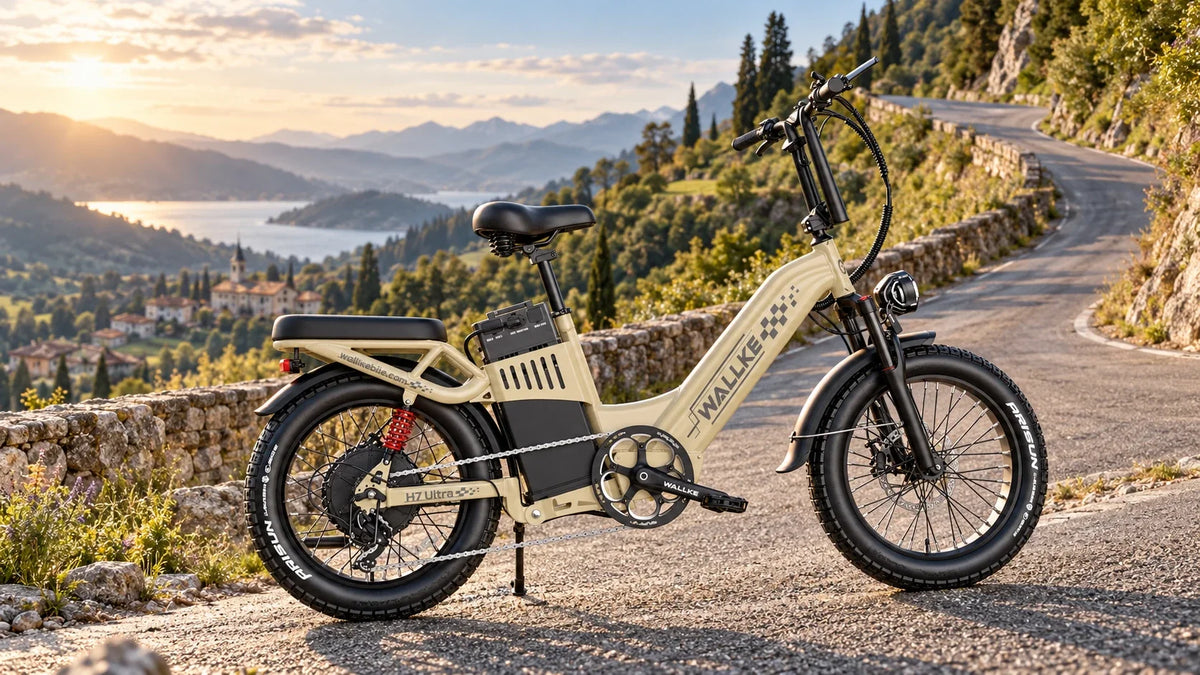
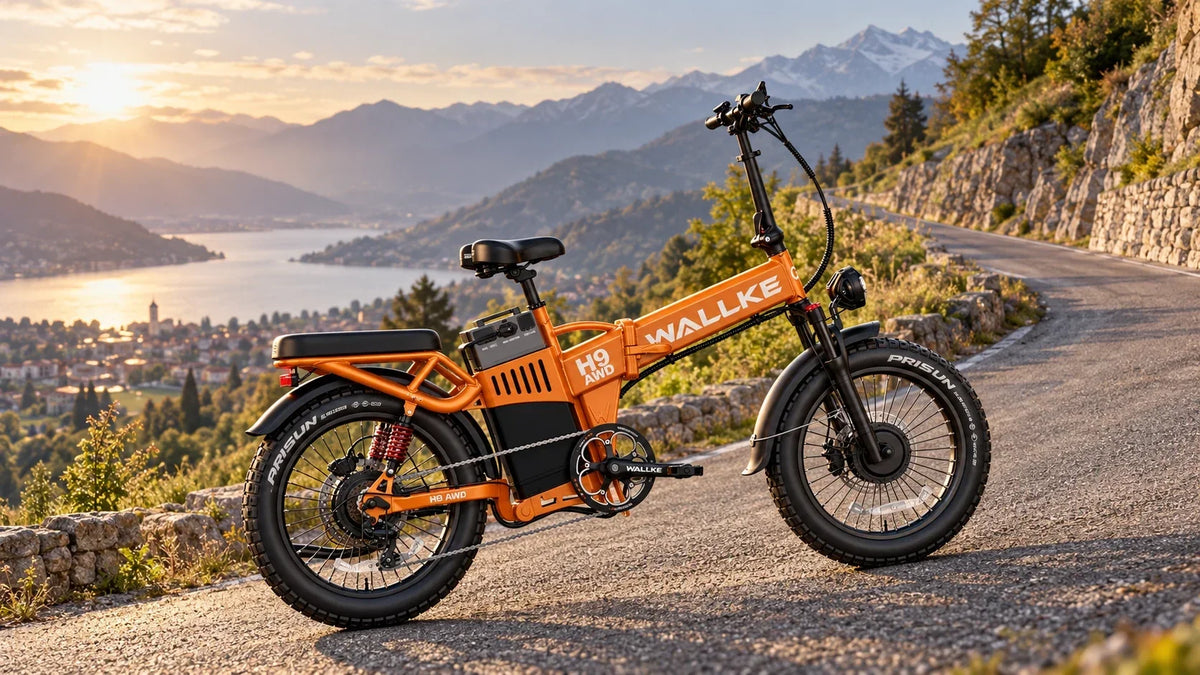
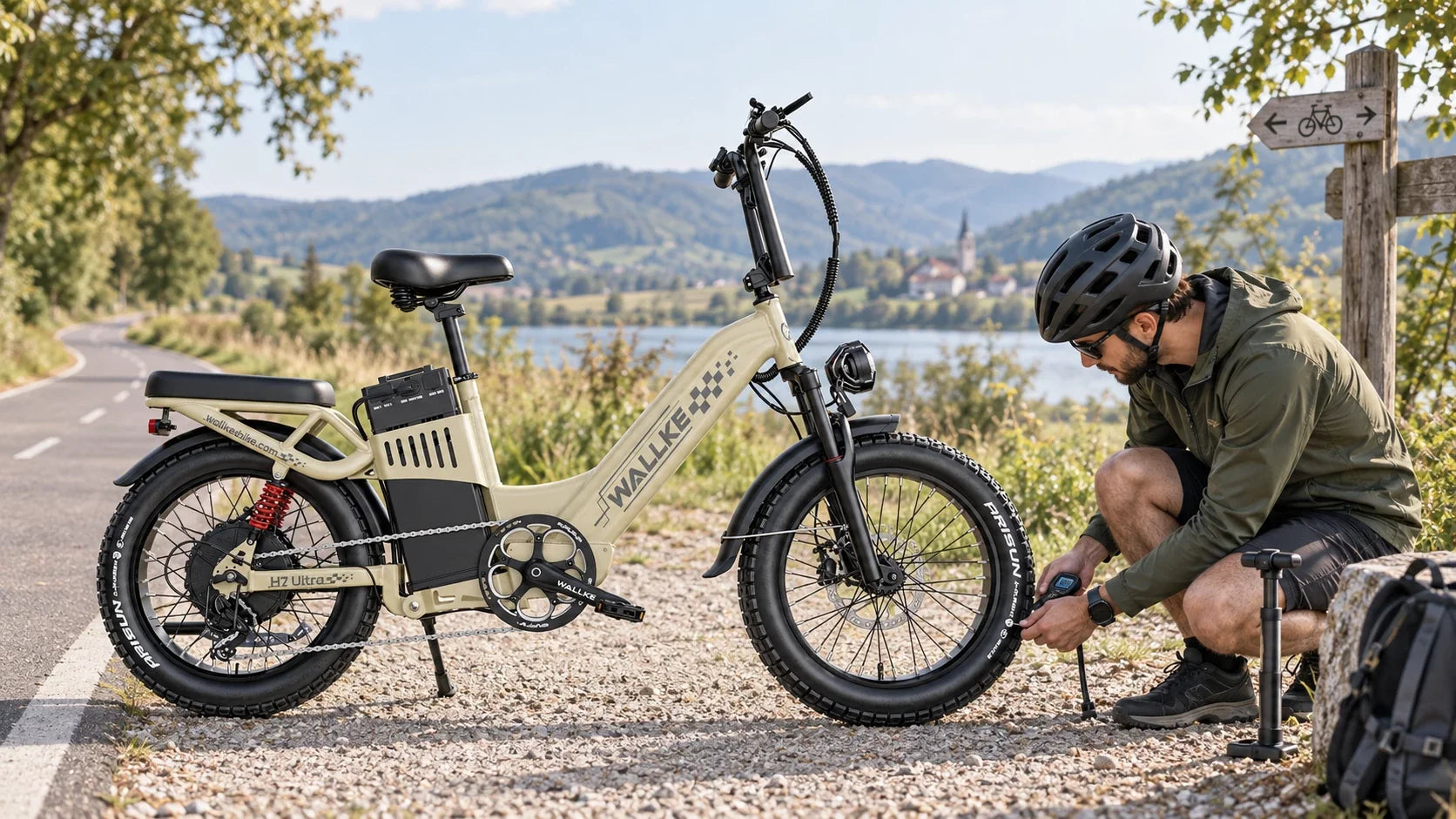
Wallke’s current European range includes two dual-motor fat-tyre models that are relevant to riders comparing traction-focused hill setups: the H7 AWD and H9 AWD.
They share much of the same hill-relevant hardware, but the frame format is different.
| Feature | Wallke H7 AWD | Wallke H9 AWD |
|---|---|---|
| Frame | Step-through | Folding step-over |
| Manufacturer-listed motor configuration | Dual 1000W motors | Dual 1000W motors |
| Published maximum torque | 95Nm + 95Nm | 95Nm + 95Nm |
| Battery | 48V 40Ah / 1,920Wh | 48V 40Ah / 1,920Wh |
| Tyres | 20 × 4in fat tyres | 20 × 4in fat tyres |
| Sensor | Cadence | Cadence |
| Suspension | Full suspension | Full suspension |
| Brakes | Hydraulic disc brakes | Hydraulic disc brakes |
| Published net weight | 62.7kg | 60.3kg |
| Published maximum payload | 181kg | 181kg |
| Best reason to shortlist | Easier mounting and step-through access | Folding layout for more compact storage |
On paper, both are more relevant to riders who want high battery capacity, fat tyres and AWD traction than to someone looking for the lightest city e-bike. These are manufacturer-listed specifications, not evidence that a particular configuration qualifies as an ordinary EPAC for public-road use in every European country. The H7 makes more sense when easier mounting is the priority. The H9 makes more sense when folding storage matters, but at a published 60.3kg net weight, its folding frame should be viewed mainly as a storage feature rather than a carry-friendly design.
There are two important cautions.
- Do not treat a claimed climbing angle as a standardised test. Unless brands use the same rider mass, battery state, surface, start method, tyre pressure and climb duration, the numbers are not directly comparable.
- Do not treat a 25km/h setting as proof of ordinary pedelec status. Continuous rated power, assistance behaviour, throttle configuration, approval status and national rules also matter.
For a side-by-side starting point, use the Wallke 48V electric bike collection or the e-bike comparison page, then verify the exact live product specification before ordering.
Common Mistakes When Buying an Electric Bike for Hills
Buying the biggest watt number
Peak power is not a complete description of climbing ability. Gearing, controller limits, motor design, thermal behaviour, tyre grip and total mass all matter.
Using one claimed incline number as proof
A “30°” or “40°” claim sounds precise, but it is only useful if the test method is known. Treat unsupported climbing-angle claims as marketing context, not a laboratory comparison.
Ignoring the descent
If the route climbs steeply, it also descends steeply. Brake condition, tyres and rider control are part of the buying decision.
Assuming fat tyres are always better
They can help on loose ground. They can also add weight and rolling resistance on tarmac.
Assuming a folding e-bike is lightweight
Folding changes storage size. It does not tell you how difficult the bike will be to lift.
Buying for one extreme ride instead of your normal week
If you ride one rough hill twice a year but carry the bike upstairs every day, the “most capable” hill machine may be the wrong bike to own.
A Practical Hill-Climbing Buying Checklist
Before you order, answer these questions:
- What is the steepest gradient on my normal route?
- How long is the longest sustained climb?
- Is the surface paved, gravel, loose dirt, mud or snow?
- Will I need to stop and restart on the hill?
- What is my total rider-plus-cargo load?
- Does the bike have a genuinely useful low gear?
- Is traction or sustained climbing efficiency the bigger problem?
- Will the battery cover the full outward and return journey with a sensible reserve?
- Are the brakes suitable for the bike’s total mass and long descents?
- Can I manage the bike’s weight when the motor is off?
- Can I source brake pads, tyres, tubes and drivetrain parts?
- Is the exact supplied configuration legal for the roads and trails I plan to use?
If a product page cannot answer the important questions, the solution is not to guess from the biggest number in the specification table.
Bottom Line
The best electric bike for hills is the bike that solves your hardest regular climb without making the rest of your riding unnecessarily difficult.
For long paved hills, start with gearing, motor efficiency and battery reserve. For loose steep climbs, pay more attention to traction and controllable power delivery. For a hilly city, add weight, fit, braking, storage and road-use rules to the decision.
A useful recommendation therefore has to start with the route, rider and ownership constraints rather than a single specification. Buy for the hill you actually ride, not for the most impressive number on the product page.
Frequently Asked Questions
What eBike is best for steep hills?
For long, sustained paved climbs, a well-geared mid-drive is often a strong choice because the motor can use the bicycle’s gears. For loose gravel, slippery surfaces, steep starts or heavy all-terrain loads, an AWD dual-motor setup can be useful because traction may be the limiting factor. The best choice depends on gradient, climb length, surface, total load, gearing, battery reserve and legal road-use requirements.
Are electric bikes any good on hills?
Yes. A suitable e-bike can make hills much easier, but hill performance varies widely. Motor layout, gearing, torque delivery, controller tuning, rider and cargo weight, battery state, tyre grip and the length of the climb all matter.
How much torque does an e-bike need for steep hills?
There is no universal torque figure that guarantees good hill climbing. Motor location, gearing, wheel size, controller tuning, total load and how the torque figure was measured all affect real-world performance. Compare torque only within the context of the complete drive system.
What is the best electric bike for hilly cities?
For hilly cities, prioritise controllable low-speed assistance, useful low gearing, reliable brakes, enough battery for repeated climbs, rider fit and a weight you can manage for parking or storage. If the route is mainly paved, AWD is not automatically necessary.
What is the best e-bike motor power for hill climbing?
Motor wattage alone is not a reliable hill-climbing score. In the EU, the familiar ordinary pedal-assisted-cycle framework uses a maximum continuous rated auxiliary motor power of no more than 250W, assistance tied to pedalling and assistance cut off before 25km/h. A well-designed 250W mid-drive can climb effectively because it can use the bike’s gears. Higher-powered configurations may fall into another legal category, so check the exact vehicle classification where you ride.
Is a mid-drive or dual-motor eBike better for hills?
A mid-drive is usually attractive when efficient climbing through the bicycle’s gears matters most. A dual-motor AWD e-bike is usually more attractive when traction at both wheels matters, such as loose surfaces, steep starts or heavier mixed-terrain use. Neither architecture is automatically better in every situation.
Are fat tyres good for steep hills?
Fat tyres can add stability and traction on loose or uneven surfaces, but they also add weight and rolling resistance. On smooth paved climbs, a lighter tyre setup with good grip may be more efficient. Tyre compound, pressure, tread and surface matter more than width alone.
Can a folding electric bike handle steep hills?
Yes, if the complete system is suitable for the climb. Check motor layout, low gearing, battery reserve, brakes, tyre grip and total weight. Folding reduces storage size; it does not automatically make the bike light or better at climbing.
Deja un comentario