



The best city e-bike is not automatically the lightest, most powerful or longest-range model. It is the bike that fits your route, your storage, your body and the rules where you ride — every ordinary day, not just on a specification sheet.
If you are comparing current options, browse Wallke electric bikes in Europe as one reference point, then compare them with the wider market. For a daily-use setup, the commuter e-bike checklist for Europe covers locks, lights, weather, maintenance and pre-ride checks in more detail.
Best city e-bike by use case: decide what “best” means first
Search results often turn “best city e-bike” into one long ranking. Real city riding is less tidy. A 5 km flat commute, a 25 km hilly commute and a train-plus-bike journey do not need the same machine.
| Your use case | Prioritise | Be careful with |
|---|---|---|
| Short, mostly flat urban trips | Low weight, simple controls, fit, lights, mudguards, easy parking | Paying for oversized batteries or heavy off-road hardware you will not use |
| Daily work commute | Reliability, range margin, brakes, rack/pannier support, service access | Buying on claimed range alone |
| Stairs or mixed train/bike travel | Low total weight, compact dimensions, removable battery, easy handling | Assuming “folding” automatically means portable |
| Long or hilly commute | Battery margin, low gearing, predictable assistance, braking, charger practicality | Focusing only on peak motor numbers |
| Cobbles, broken roads or light gravel | Tyre volume, grip, comfort, wheel strength and controlled braking | Very narrow tyres or unnecessary mass |
| Groceries and errands | Rear rack, pannier compatibility, payload, stable parking | Handlebar bags that interfere with steering or lights |
| Riding with a child | Manufacturer-approved child-seat or cargo compatibility, payload, stable handling and local rules | Assuming any rack can safely accept a child seat |
| Small flat or limited storage | Real folded dimensions, battery removal, manoeuvrability indoors | Judging storage needs from wheel size alone |
Choose the bike around the hardest part of your normal week. That may be a staircase, a steep hill, wet winter braking, a secure parking problem or a 40 km round trip. Solve that first.
What makes a good city electric bike?
A good city electric bike should be easy to live with. In practice, this eliminates bikes that look impressive on paper but are awkward to store, charge, carry or maintain.
- Fit: you can start, stop and put a foot down confidently.
- Handling: low-speed steering remains predictable around junctions and pedestrians.
- Weight: you can move the bike through the places it actually has to go.
- Brakes: lever feel is predictable in wet and dry conditions, and replacement pads are obtainable.
- Battery: it covers the real round trip with reserve, not only an ideal test figure.
- Charging: the battery or bike can be charged where you live and work.
- Utility: lights, mudguards, rack mounts and luggage options fit your routine.
- Support: manuals, consumables, replacement parts and service routes exist.
- Road suitability: the exact supplied configuration fits the legal category you intend to use.
That is also why “best city e-bike for women” is not a useful technical category on its own. Rider height, reach, standover, saddle range, hand comfort and low-speed control matter more than a gender label. A step-through frame can be useful for many riders, regardless of gender.
Start with the commute, not the motor
Before comparing bikes, write down your actual route. Do not start with watts, torque or battery capacity.
1. Measure the full round trip
Include detours, the ride to the station, lunch errands and the distance to secure parking. A commute that looks short on a map can become much longer over a week.
2. Mark the gradients and stop-start sections
Hills affect energy use, gearing and braking. Frequent junctions make smooth low-speed assistance more important than headline speed.
3. Note the surface
Fresh cycleway, patched asphalt, cobbles and tram-track areas ask different things from tyres and suspension. Fat tyres can improve comfort on rough surfaces, but they also add mass and rolling resistance. Bigger is not automatically better in a city.
4. Include the “off-bike” part of the journey
How far do you push the bike? Is there a lift? Does the bike fit through the building entrance? Is the station platform crowded? Where will you charge it?
This is where many online recommendations fail. They review the ride but not the ownership.
Weight, stairs and storage: the specification many buyers underestimate
Weight repeatedly appears in real commuter discussions for a reason. A powerful e-bike is not useful if you cannot get it into your flat, storage room or train connection.
Before buying, answer three questions:
- Do I ever need to lift the whole bike?
- Can I remove the battery before moving or charging it?
- Does the folded or full-size bike fit the real storage space?
If you live several floors up without a lift, a lighter city e-bike can be a better commuter than a more capable machine with a larger battery. If the bike stays in a secure ground-floor room, the trade-off may be different.
Battery capacity and realistic range
Range matters, but a single “up to” number is a weak way to compare city electric bikes.
Battery energy is commonly expressed in watt-hours (Wh). It gives a better basis for comparing battery size than amp-hours alone when voltages differ. It still does not tell you exactly how many kilometres you will ride.
Real range changes with:
- assist level and rider input;
- speed and stop-start traffic;
- hills and wind;
- bike, rider and luggage weight;
- tyre type and pressure;
- temperature;
- battery age and condition.
For commuting, build in reserve. Do not plan a daily route that only works if the battery achieves the best-case figure every day.
Removable battery or fixed battery?
A removable battery is valuable when the bike stays in a garage, shared store or outdoor parking area but charging happens indoors. It can also reduce the mass you need to move in some situations. Check how easy the battery is to remove, how it locks, and whether a replacement is available for the exact model.
For a Wallke replacement battery, confirm the exact bike model and battery version before ordering. Battery connectors, capacity options and compatible hardware can vary by model or production version, so use the relevant product documentation or Wallke support to confirm compatibility.
Motor position and assist feel matter more than a big power number
A city bike spends a lot of time starting, slowing and changing pace. That makes control important.
Rear-hub motor
A rear-hub system can be simple and effective for commuting. It drives the rear wheel independently of the bike’s gearing. On flatter routes, a well-tuned hub motor can be all you need.
Mid-drive motor
A mid-drive sends power through the bicycle drivetrain. It can use the gears to work efficiently across changing gradients and often gives a more bicycle-like balance. The trade-off is that drivetrain wear, shifting technique and service complexity can matter more.
Neither location automatically proves better reliability or value. The complete system matters.
Torque sensor vs cadence sensor
A torque sensor responds to pedal force. A cadence sensor primarily detects crank movement. In stop-start urban traffic, a well-tuned torque system often feels more proportional. A cadence system can suit riders who want strong support with light pedal pressure.
Controller tuning is critical. Two bikes with the same sensor label can feel very different. See the detailed torque sensor vs cadence sensor comparison before treating either sensor as automatically “better”.
Brakes, tyres, lights, mudguards and cargo: the daily-use features
Brakes
More system mass and higher speeds increase the demand on the brakes. Look for controlled lever feel, suitable rotor and pad availability, and a service route you can actually use. Hydraulic disc brakes are common on heavier commuter e-bikes, but component quality and maintenance still matter.
Tyres
Choose tyres for your surface, not for appearance. Smooth urban routes favour efficient road-oriented tyres. Broken streets and light gravel may justify more volume and tread. Very wide fat tyres can add comfort and traction, but also weight and drag.
Lights and mudguards
For a daily commute, integrated lights and proper mudguards often deliver more value than another display mode. Check local equipment rules as well as your own visibility needs.
Rack and panniers
A laptop, groceries, lock and rain layer quickly turn a leisure ride into a load-carrying problem. A rear rack or compatible pannier system keeps that weight off your shoulders and away from the handlebar.
Commuting with a child
Treat a child seat or cargo setup as part of the bike’s load system, not as an accessory to add later. Confirm that the manufacturer approves the mounting method, check the rack or frame load rating and total payload, and make sure the bike remains stable when loading and parking. Rules for carrying children can differ by country, so check the requirements where you ride.
Step-through, folding or conventional frame?
| Frame type | Why it can work in a city | What to verify |
|---|---|---|
| Step-through | Easy mounting and dismounting, useful in frequent stop-start riding | Frame stiffness, fit, battery placement, total weight |
| Folding | Can reduce storage footprint and may help with some mixed-mode trips | Net weight, folded size, hinge quality, operator rules |
| Conventional/diamond | Often simple, efficient and familiar to experienced cyclists | Standover, reach and comfort with city clothing and luggage |
| Compact/fat-tyre | Can add comfort and confidence on rough surfaces | Mass, tyre drag, storage width and manoeuvrability |
If your search is specifically for a foldable city e-bike, measure the storage space before looking at product photos. “20-inch folding” can describe bikes with very different folded dimensions and weights.
Shopping for a city e-bike under €1,000 or €2,000: where should you compromise?
A hard budget ceiling is useful, but price alone does not tell you whether a bike will work as a daily commuter. Within either budget, protect the features that affect fit, braking, charging, maintenance and road suitability first. Treat displays, oversized batteries and off-road hardware as secondary if your route does not need them.
Do not compromise first on:
- correct fit and controllable handling;
- braking appropriate to the bike and use;
- clear battery and charger compatibility;
- road-use documentation for the exact configuration;
- replacement tyres, brake pads and other normal wear parts;
- a realistic service and support route.
Features you may be able to simplify:
- large colour displays and app extras;
- oversized batteries for a short commute;
- full suspension on smooth urban roads;
- very wide tyres when your route is almost entirely good asphalt;
- extreme peak-power claims that do not solve your actual commute.
Prices vary across countries, taxes, promotions and model years. This guide therefore does not invent a Europe-wide “average city e-bike price”. Check live prices only after you know the features you actually need.
What e-bikes should you stay away from?
Avoiding the wrong e-bike is less about blacklisting brands and more about spotting missing information before you buy.
Pause the purchase if:
- the seller cannot explain the exact motor rating, assistance behaviour or supplied road configuration;
- the battery and charger do not have clear compatibility information;
- claimed range has no stated conditions and leaves no practical reserve for your route;
- bike weight, payload or dimensions are missing;
- there is no accessible manual, serial-number process or support contact;
- replacement brake pads, tyres, tubes or other consumables are difficult to identify;
- the bike is too heavy for your stairs, storage or public-transport connection;
- the marketing focuses on unrestricted speed without explaining legal road use.
Reliability is not just “will the motor fail?”. For a commuter, reliability also means you can obtain a tyre, brake pad, charger, battery or controller when you need one. Also check whether key electrical components such as the display, controller, battery connector or charger are model-specific, and how replacements would be sourced if the bike is several years old. If you are comparing Wallke models, the Wallke e-bike comparison tool helps put specifications side by side; parts availability should still be checked for the exact model.
How fast can a city e-bike go in Europe? Check the vehicle category first
Europe does not have one road-use rulebook. EU rules, national law and local access rules can all matter, while non-EU countries such as the UK and Switzerland have their own frameworks.
Within the EU, Regulation (EU) No 168/2013 excludes from its type-approval scope pedal cycles with pedal assistance when the auxiliary electric motor has a maximum continuous rated power of no more than 250 W, motor output cuts when the rider stops pedalling, and assistance is progressively reduced and finally cut off before 25 km/h.
This is the Article 2(2)(h) exclusion from the scope of Regulation (EU) No 168/2013 for qualifying pedal-assisted cycles. It is not a complete road-legality test for every EU country, and it does not describe the rules for all European e-bike categories. Helmet rules, throttles, speed-pedelec treatment, insurance, registration, lighting and access to cycle facilities can vary.
Use the consolidated EU regulation on EUR-Lex as a primary source, then check the current national and local rules for the place you will ride.
Where Wallke fits — and where a lighter city e-bike may fit better
Wallke should not be presented as the automatic answer for every city rider. The current European H7 and H9 products are substantial, wide-tyre machines with large batteries and dual-motor configurations. That creates strengths, but also clear trade-offs.
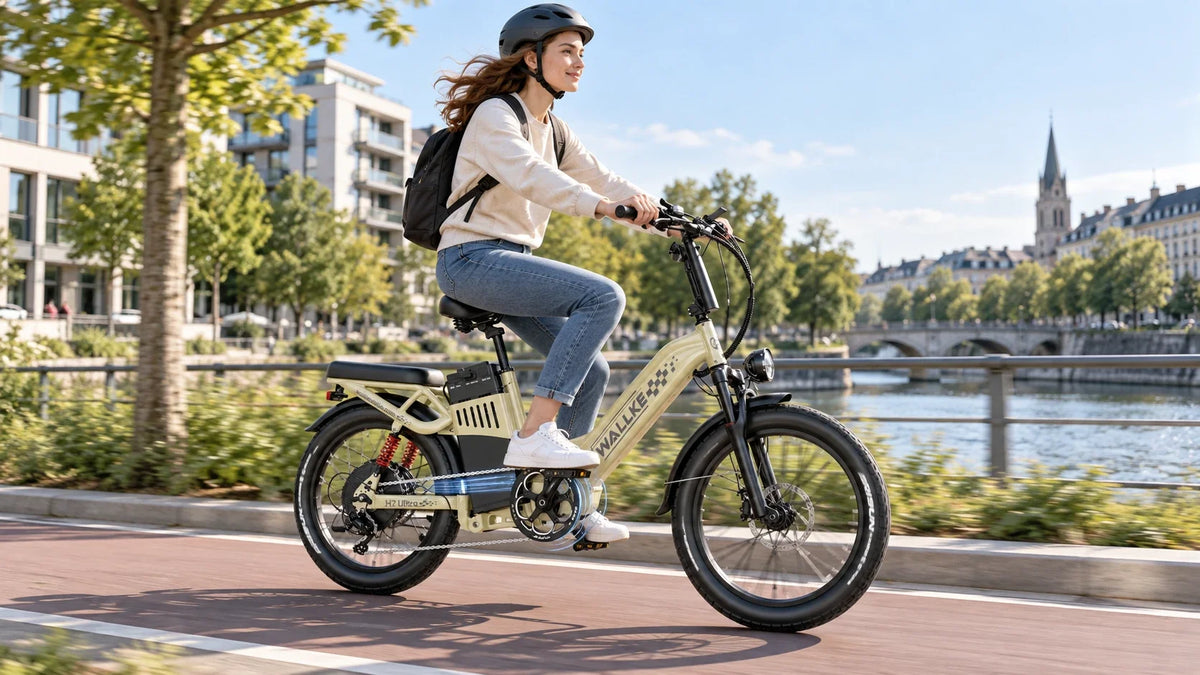
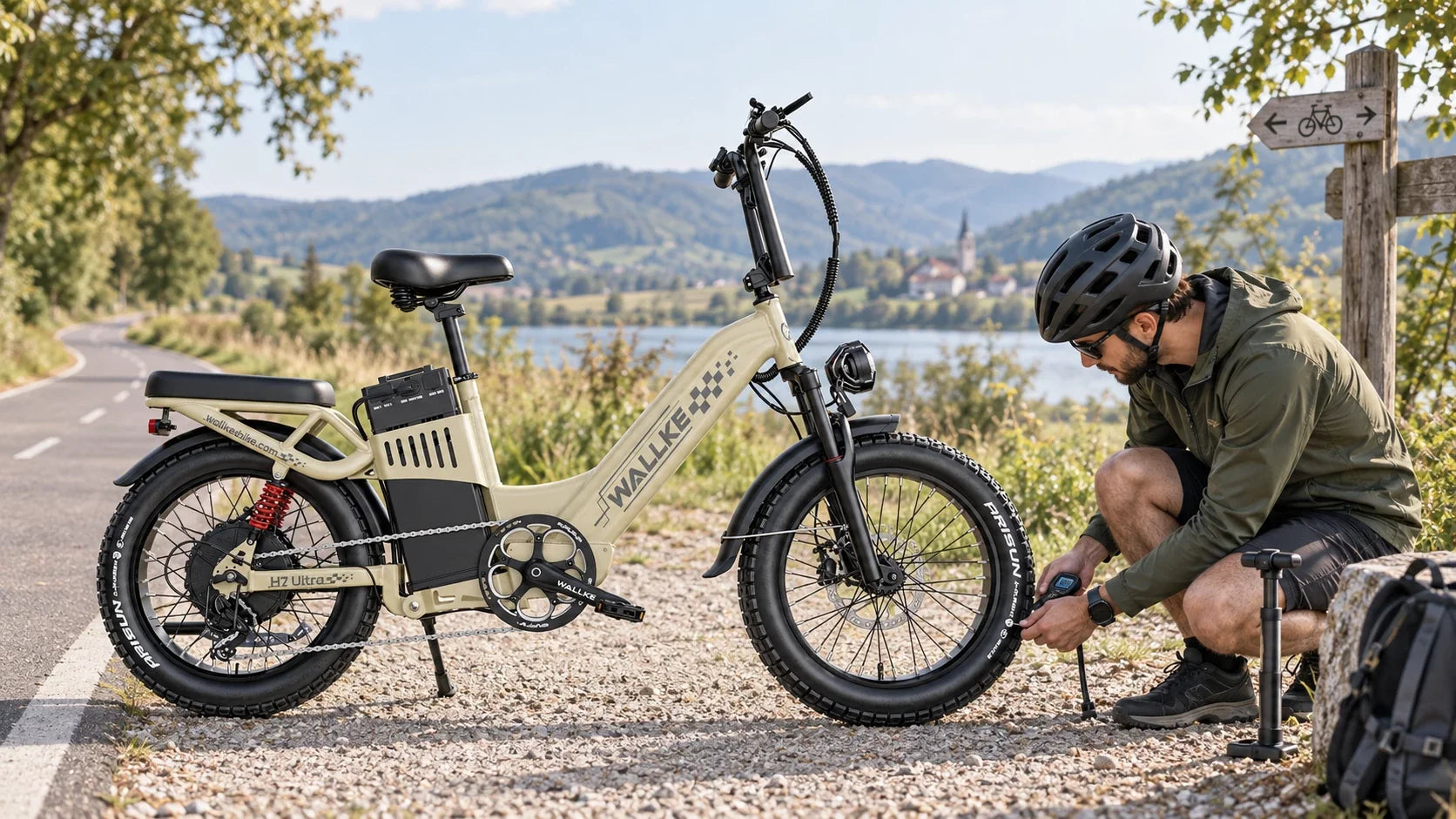
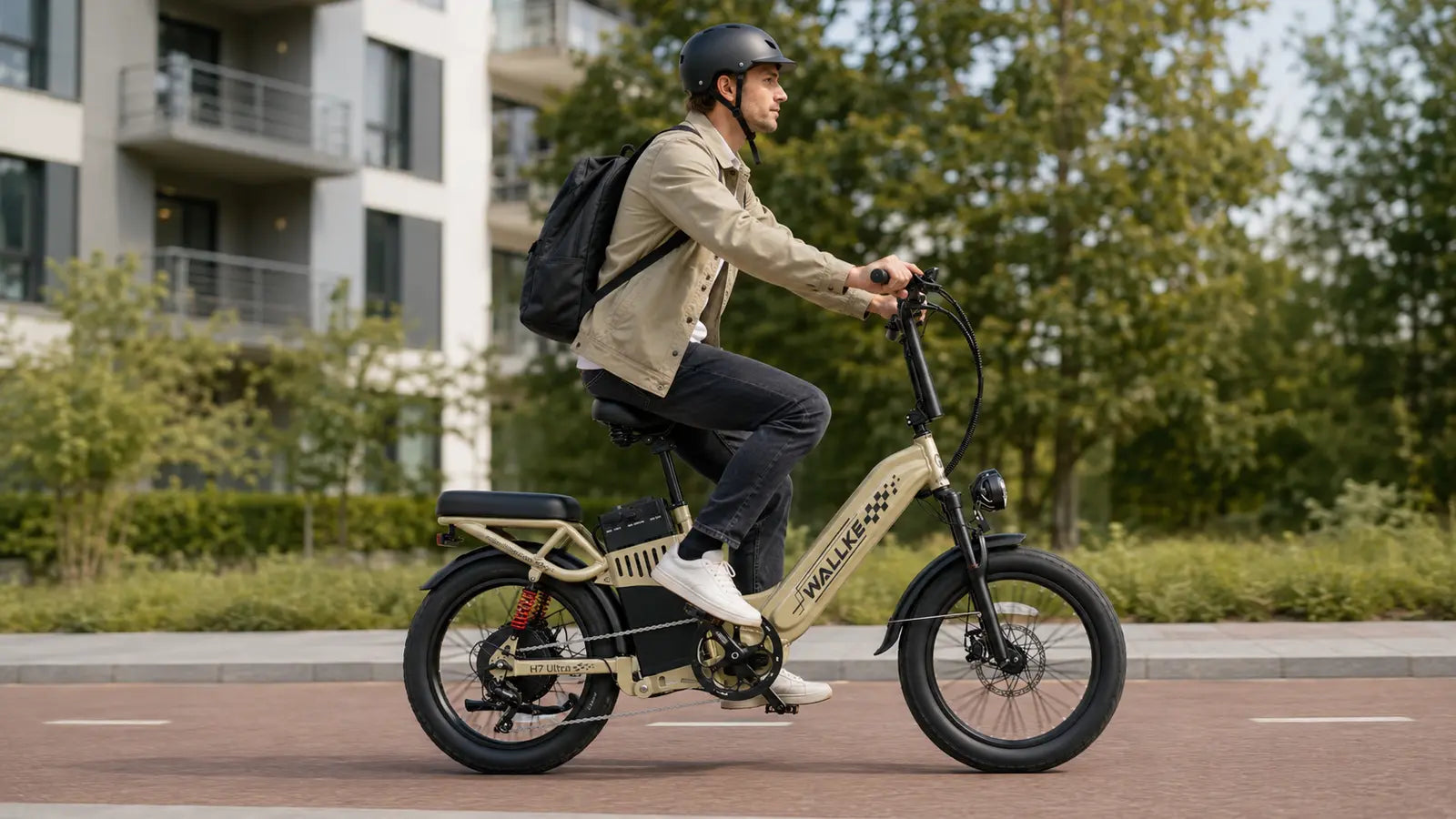
Wallke H7 Step-thru
The Wallke H7 Step-thru combines a low-step frame, 20 × 4-inch tyres, full suspension, hydraulic disc brakes, integrated lights and a rear rack. At the time of this guide’s September 2026 review, the current European product page lists a net weight of 62.7 kg and a dual 1000 W motor configuration.
That makes it more relevant to riders who prioritise easy mounting, robust construction, larger loads and rougher surfaces than to someone carrying a bike up stairs every day. The exact supplied configuration and local road-use category need to be checked before public-road use.
Wallke H9 AWD
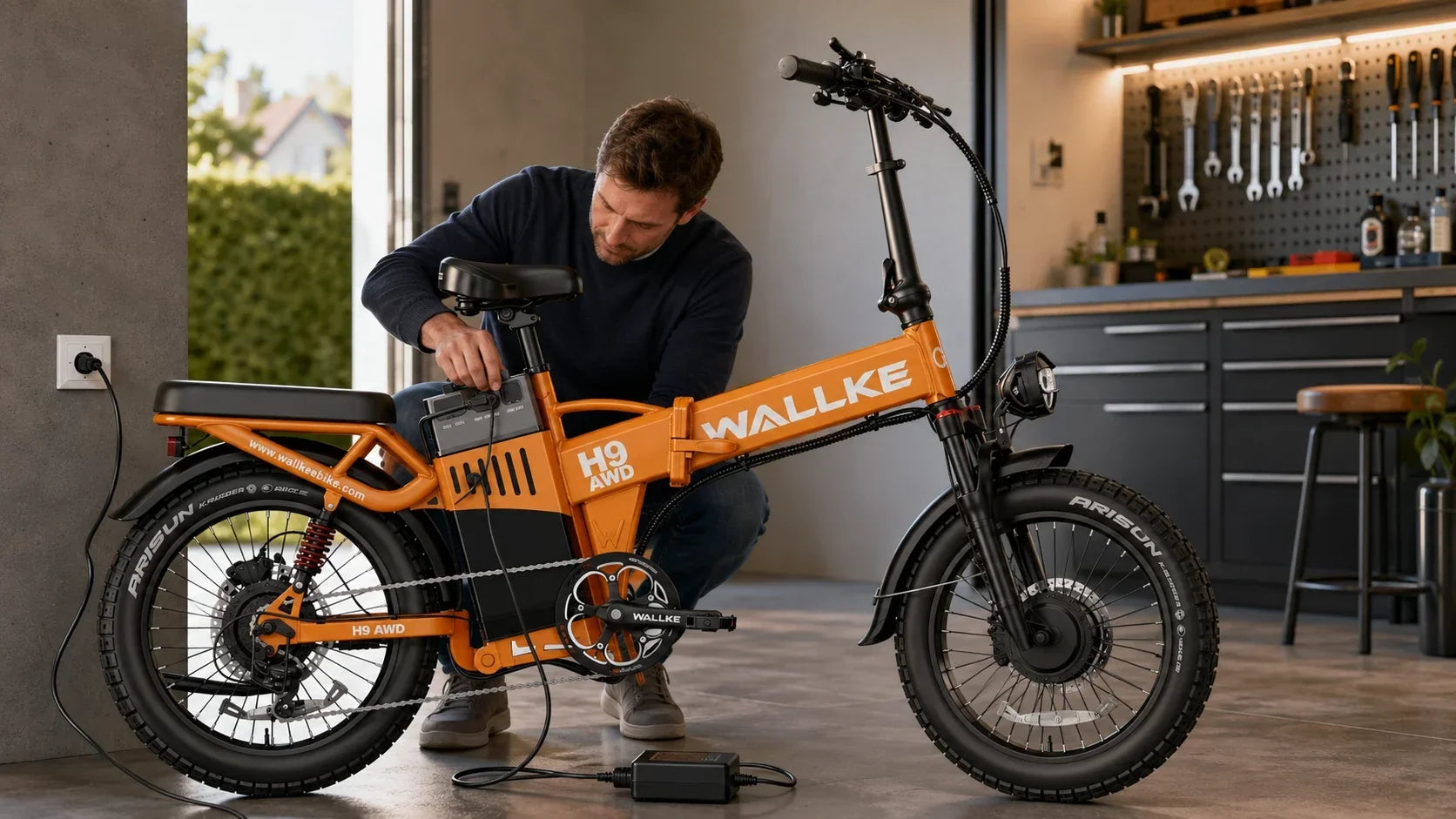
The Wallke H9 AWD has a folding frame, 20 × 4-inch tyres, full suspension, hydraulic brakes, a rear rack and a removable 48 V 40 Ah battery in the currently displayed European configuration. The same page lists a 60.3 kg net weight and dual 1000 W motors.
Folding is a storage feature here, not a lightweight-portability claim. The H9 may reduce its footprint when stored, but it is not the obvious choice for carrying up station stairs. Again, road use depends on the exact supplied configuration and local rules.
If these heavy-duty trade-offs match your route, check the current H7 and H9 product pages directly for the latest weight, battery and drive specifications before choosing a configuration. If your commute is smooth, short and includes stairs or frequent train transfers, a much lighter road-oriented city e-bike may be the more rational choice.
City e-bike vs commuter e-bike: is there a real difference?
The terms overlap heavily.
A city e-bike usually emphasises urban handling, utility and comfort. A commuter e-bike emphasises repeated transport to work or school, so reliability, luggage, weather protection and range margin receive more attention.
In practice, a good city e-bike can be an excellent commuter. The question is whether it can repeat the journey five days a week without creating a new problem at home, at work or on the route.
Best city e-bike buying checklist
- Route: full round-trip distance, hills and surfaces mapped
- Fit: safe starts, stops, reach and standover confirmed
- Weight: manageable through every stair, door and platform
- Storage: full and folded dimensions checked where relevant
- Battery: realistic reserve and practical charging plan
- Assist feel: smooth enough for low-speed urban riding
- Brakes: predictable and serviceable
- Tyres: matched to asphalt, cobbles, gravel or mixed surfaces
- Utility: lights, mudguards, rack and pannier needs solved
- Parts: normal wear items and key electrical parts identifiable
- Support: manual, warranty terms and contact route available
- Legality: exact supplied configuration checked for your country
Do this before you compare cosmetic details. It turns a vague price comparison into a shortlist based on the things you will deal with every day.
Frequently asked questions
What is the best e-bike for city riding?
The best city e-bike is the one that fits your route, storage and body. For most riders, prioritise manageable weight, predictable assistance, dependable brakes, useful battery capacity, practical charging, lights, mudguards and luggage support before chasing maximum motor power.
Are electric bikes good for commuting?
Yes, when the bike fits the route and can be parked, charged and maintained reliably. E-bikes are especially useful when hills, distance or carrying work items make a normal bicycle less practical. The main risks are buying too much weight, too little real range or a configuration that does not fit local road rules.
Which electric bike is best for daily use?
For daily use, reliability and ownership practicality matter more than a single headline specification. Look for comfortable fit, predictable brakes, range reserve, weather-ready equipment, easy charging, common wear parts and a clear support route.
How much does a city electric bike cost?
There is no useful single Europe-wide price because countries, taxes, promotions and specifications vary. Set your budget, then protect the essentials: fit, brakes, battery and charger documentation, road suitability, parts availability and service support. Simplify non-essential display, suspension or battery features before compromising on those basics.
How fast does a city e-bike go in Europe?
Rules depend on the vehicle category and country. Under the Article 2(2)(h) exclusion in Regulation (EU) No 168/2013, qualifying pedal-assisted cycles must meet conditions including no more than 250 W maximum continuous rated motor power, motor output cutting when the rider stops pedalling, and assistance being progressively reduced and cut off before 25 km/h. Other e-bike categories and non-EU European countries can follow different rules.
What e-bikes should I stay away from?
Avoid buying until you can resolve missing information about the exact road configuration, motor and assistance behaviour, battery and charger compatibility, bike weight, payload, replacement parts, manuals and service support. A bike that cannot be maintained or does not fit your storage is a poor commuter even if its headline specifications look impressive.
Is a folding e-bike best for city commuting?
It can be, especially when storage space is limited. But folding does not automatically mean lightweight. Check net weight, folded dimensions, hinge design and public-transport rules. If you carry the bike often, portability may matter more than battery size.
Should I choose a removable battery for a city e-bike?
A removable battery is useful when the bike cannot be parked next to a power outlet or when you want to charge indoors. Check how securely it locks, how easy it is to remove, its weight, and whether a correct replacement is available for the exact model.
Is a torque sensor better than a cadence sensor for commuting?
Not always. Torque sensing usually gives more proportional assistance and can feel easier to modulate in stop-start traffic. Cadence sensing can suit riders who want strong support with light pedal pressure. Controller tuning, gearing and the complete bike matter as much as the sensor label.
Can I take a city e-bike on a train?
It depends on the operator, route and bike. Full-size e-bikes may require reservations or be restricted at busy times, while folding-bike rules can differ. Battery and size rules can also vary. Check the current transport operator policy before relying on a mixed train-and-bike commute.
Final takeaway
The best city e-bike is the one that removes friction from the whole journey. It should fit, stop predictably, cover the real route with reserve, carry what you need and fit through the places you use every day.
Do not buy the motor first and solve the commute later. Start with your route, stairs, storage, load and local rules. Then compare battery, assist feel and hardware. That approach is less exciting than chasing the biggest number on a product page — and much more likely to produce a bike you still enjoy using after the first month.
Pagamento rata
Pagamento rata
Pagamento rata
Pagamento rata