



If you are comparing higher-capacity models, start with Wallke’s 48V electric bike collection, then verify the exact payload figure on the current product page. A large motor, dual motors or fat tyres do not by themselves prove that an e-bike can carry more weight.
How Much Weight Can an Electric Bike Carry?
There is no single electric bike weight capacity that applies to every model. The correct number is the manufacturer’s published limit for the exact bike and configuration you are considering.
For buying decisions, the most useful question is:
This is why a search for an “electric bike 150 kg capacity” or “electric bike weight limit 400 lbs” cannot be answered from the number alone. First check what the manufacturer includes in that number.
| Capacity or rider figure | Approx. metric / imperial equivalent | What to remember |
|---|---|---|
| 150 kg | 331 lb | If 150 kg is the maximum payload, a 150 kg rider would normally leave no room for other counted load. |
| 300 lb rider | 136 kg | The bike’s payload should be above 136 kg after clothing, locks, luggage and other counted items are included. |
| 350 lb rider | 159 kg | Available choices narrow because normal riding gear also uses part of the published capacity. |
| 400 lb rider | 181 kg | A 181 kg / roughly 400 lb payload is not the same as being suitable for a 400 lb rider plus equipment. |
Electric Bike Weight Capacity: What Counts Towards the Limit?
E-bike weight, payload capacity and maximum permissible total weight are related terms, but they are not interchangeable.
| Term | What it usually means | What to check |
|---|---|---|
| E-bike / net weight | The weight of the bicycle itself, usually including its standard battery. | Important for lifting, stairs, storage and transport. It is not the same as carrying capacity. |
| Payload / maximum load | Usually the rider plus luggage, accessories and other carried items. | Read the manufacturer’s definition. Do not assume every brand counts items in exactly the same way. |
| Maximum permissible total weight | May mean bike + rider + cargo + accessories. | If the bicycle itself is included, subtract its weight before calculating how much rider and cargo load is available. |
Do not assume that a capacity number refers only to the person sitting on the bike. Clothing, a lock, panniers, tools, water and other equipment may all count towards the relevant limit.
How to Calculate Your Real E-Bike Load
Add the weight that will normally be carried on the bike:
- your body weight;
- normal riding clothing and footwear;
- backpack, panniers or rack luggage;
- locks, bottles and tools;
- child seats or mounted equipment, where approved;
- shopping, work equipment or other cargo.
Then compare that total with the manufacturer’s stated payload definition. If your normal load is close to the maximum, choose a model with more verified capacity rather than planning to ride over the published limit.
Is a 150 kg Electric Bike Capacity Enough?
A 150 kg electric bike capacity is about 331 lb. Whether that is enough depends on what the 150 kg figure means and how much you actually carry.
| Example | Total carried load | Against a 150 kg payload |
|---|---|---|
| 120 kg rider + 8 kg gear | 128 kg | 22 kg remains below the stated payload. |
| 140 kg rider + 10 kg gear | 150 kg | The full stated payload is already used. |
| 150 kg rider + any additional counted load | More than 150 kg | The published payload would be exceeded. |
These are arithmetic examples, not a universal safety margin. The manufacturer’s own definition and instructions take priority.
300 lb, 350 lb and 400 lb Riders: What Capacity Should You Look For?
The searches “e bike weight limit 300”, “electric bike weight limit 350” and “electric bike weight limit 400 lbs” often hide the same mistake: matching rider weight to an identical maximum-load number.
| Rider weight | Approx. metric weight | What an equal payload rating would mean |
|---|---|---|
| 300 lb | 136 kg | A 136 kg payload leaves essentially no capacity for clothing, locks or cargo. Look above your real total load. |
| 350 lb | 159 kg | A 159 kg rating is not the same as “suitable for a 350 lb rider” once other carried weight is included. |
| 400 lb | 181 kg | A 181 kg payload is already approximately equal to the rider’s body weight. There is effectively no useful payload room left. |
| 500 lb | 227 kg | Only consider a model if the manufacturer explicitly publishes sufficient capacity and clearly defines what the rating includes. |
Can a 300 lb person ride an e-bike?
Yes, provided the specific e-bike is rated above the rider’s full carried load and fits them properly. A 300 lb rider is about 136 kg, so a bike with a 136 kg maximum payload is not a practical match once normal gear is added.
What about a 350 lb rider?
A 350 lb rider weighs about 159 kg. At this point, the difference between a 159 kg rating and a higher verified payload becomes important because locks, clothing, luggage and other equipment still need to be counted.
Electric Bike Weight Limit 400 lbs: Is That Enough for a 400 lb Rider?
Usually not if 400 lb is the bike’s maximum payload. A 400 lb rider weighs about 181 kg. If the manufacturer’s 400 lb / 181 kg rating includes the rider plus cargo and accessories, the rider alone has already used essentially all of the available payload.
That is the key distinction:
For someone who weighs around 400 lb, look for a manufacturer-rated capacity that is genuinely above the rider’s own weight and still leaves room for the items that count towards the load.
What Happens If You Exceed an E-Bike’s Weight Limit?
Going slightly over a published number does not mean a bicycle will instantly fail. It does mean you are using it outside the load the manufacturer says it is designed to carry.
Extra load can affect several systems at once:
- Braking: more mass requires the brakes and tyres to manage more energy during a stop.
- Wheels and spokes: impacts, potholes and kerbs create higher loads at the rims and spokes.
- Tyres: pressure, casing strength and rated load become more important.
- Suspension: forks and shocks may sit deeper in their travel or bottom out more easily if they are not set up for the load.
- Handling: steering, cornering and low-speed balance can change with a heavier total system.
- Motor and battery demand: higher mass can increase the energy needed for starts and climbs, so range may fall and the drive system can work harder.
There can also be warranty implications if the bicycle is used beyond its stated maximum. Check the current warranty and owner’s manual rather than relying on forum anecdotes.
Motor Power Does Not Determine Weight Capacity
A more powerful e-bike does not automatically support a heavier rider.
A stronger motor may improve acceleration or climbing under load, but it does not set the structural limit of the frame, fork, wheels, tyres, rack, brakes or suspension. A dual-motor e-bike can still have a lower payload rating than a less powerful bike designed around a higher-capacity chassis.
The same applies to fat tyres. They may change traction, air volume and ride feel, but tyre width alone is not proof of a higher electric bike weight capacity.
Heavy Rider Buying Checks Beyond the Weight Limit
Once the payload calculation works, the next questions are fit, braking, wheels, tyres, battery, mounting and everyday ownership. Those subjects overlap with a different search intent, so they are covered in more detail in Wallke’s electric bike for heavy riders guide.
For this weight-limit decision, keep the shortlist simple:
- confirm the exact manufacturer-stated payload;
- confirm what that figure includes;
- calculate rider + normal carried load;
- check that the bike fits your height and mobility;
- check wheels, tyres and braking hardware;
- check the e-bike’s own weight if stairs, racks or transport matter.
Wallke Weight Capacity Example: H7 AWD and H9 AWD
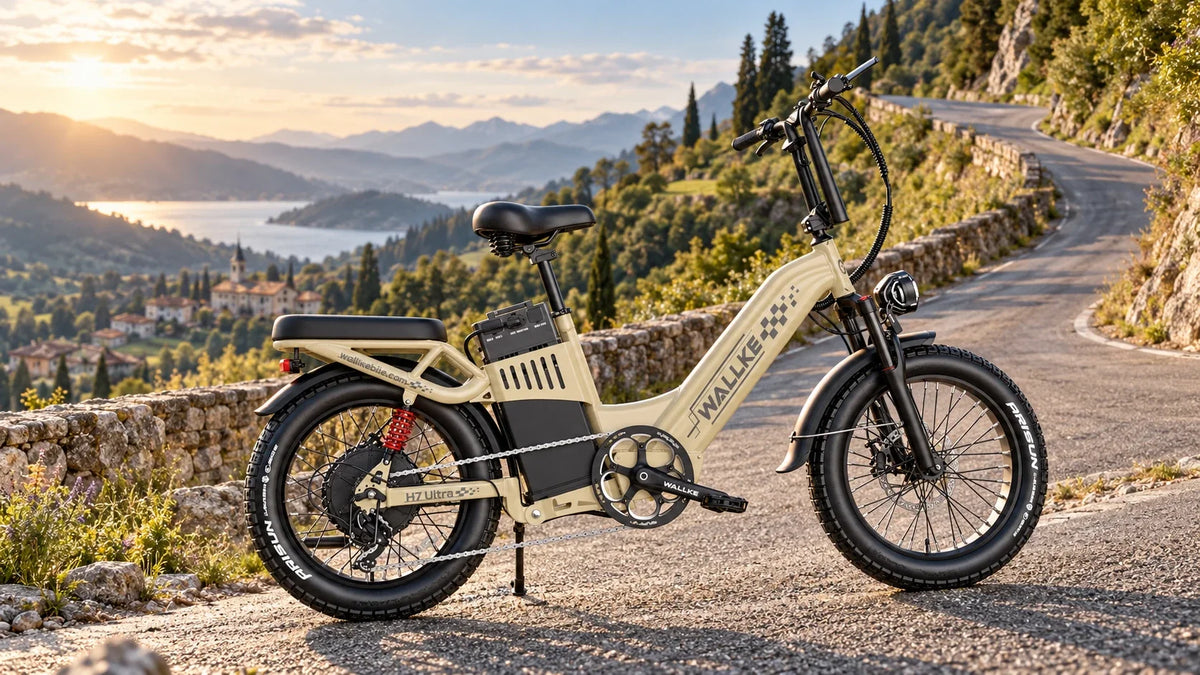
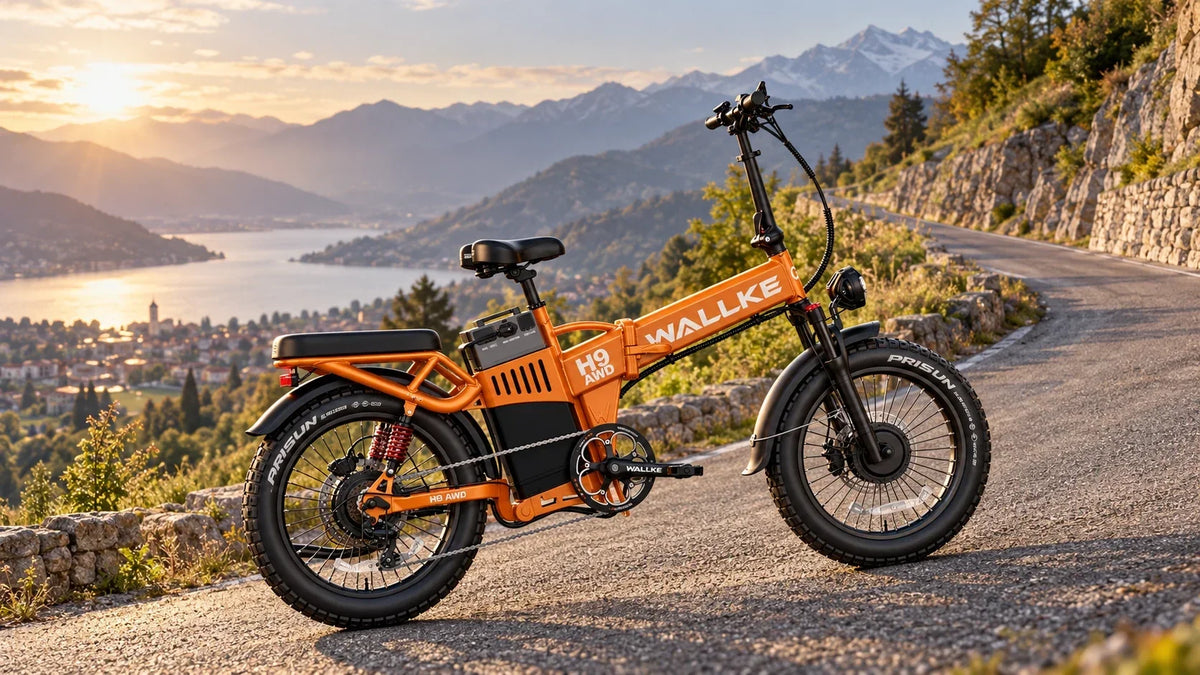
Wallke’s current European specifications provide a useful example. The Wallke H7 AWD step-through and Wallke H9 AWD are currently listed with a maximum payload of 181 kg.
The current 40Ah versions are also listed at approximately 62.7 kg net weight for the H7 AWD and 60.3 kg for the H9 AWD. This shows why “e-bike weight” and “e-bike weight limit” should never be treated as the same thing.
| Example rider | Rider weight | Nominal room below 181 kg payload | Practical reading |
|---|---|---|---|
| 150 kg rider | 150 kg / 331 lb | 31 kg | Potentially within the published payload once all counted items are added, but calculate the full load first. |
| 300 lb rider | About 136 kg | About 45 kg | There is theoretical room below 181 kg, but clothing, luggage and accessories still use part of it. |
| 350 lb rider | About 159 kg | About 22 kg | The remaining room is smaller, so the real carried load matters more. |
| 400 lb rider | About 181 kg | Effectively none | Do not read the 181 kg payload figure as an endorsement for a 400 lb rider plus normal equipment. |
This is not a claim that either model suits every heavier rider. Fit, component setup, terrain, transport needs, local road rules and the exact supplied configuration still matter. Check the live specification before ordering.
How Much Do E-Bikes Weigh in kg?
There is no single useful number for “e-bike weight in kg”. Lightweight city e-bikes, trekking bikes, cargo bikes and large-battery fat-tyre models can differ substantially.
- Bike weight affects lifting, storage, transport and low-speed handling.
- Weight capacity affects whether the bicycle is rated for the rider and carried load.
A heavy e-bike is not automatically a high-capacity e-bike, and a lighter bike is not automatically weak. Use the published rating for the exact model.
Does Rider Weight Reduce E-Bike Range?
Usually, yes. Moving more total mass requires more energy, especially during repeated starts and climbing. The effect is not a fixed percentage because gradient, speed, wind, temperature, tyre pressure, assist level and riding style all matter.
A range claim measured with a lighter rider on flat ground should therefore not be treated as a guarantee for a heavier rider on hills. If range matters, compare battery energy in watt-hours and look at the test conditions behind the claimed distance.
Europe: Weight Capacity and Road Legality Are Separate Questions
Payload capacity does not determine whether an e-bike is legally treated as an ordinary bicycle on public roads. A bike may have a high load rating while its motor, assistance speed or throttle configuration places it in a different regulatory category.
Check the exact configuration supplied in your country and the rules that apply where you plan to ride. For a broader purchase process, Wallke’s guide to choosing the right e-bike covers the main practical checks before you narrow the decision to one specification.
Final Electric Bike Weight Limit Checklist
- Know your body weight in kg.
- Add clothing, locks, bags and normal cargo.
- Read the manufacturer’s definition of payload or total permissible weight.
- Do not match your body weight exactly to the maximum capacity.
- Check tyre, wheel, brake and suspension suitability.
- Confirm frame fit and ease of mounting.
- Check the bike’s own weight before planning stairs, car transport or train travel.
- Verify the exact model and variant, not only the model family name.
- Check local road-use rules separately from payload capacity.
Bottom line: there is no universal body weight that is “too heavy for an e-bike”. The relevant limit is model-specific. Compare your complete carried load with a clearly defined manufacturer rating, then check that the rest of the bike is suitable for your fit and intended use.
FAQ: Electric Bike Weight Limits
What is the weight limit on an electric bike?
It depends on the model. Some manufacturers publish a payload limit for the rider and cargo, while others publish a maximum total permissible weight that can include the bike. Check the exact definition before comparing numbers.
How much weight can an electric bike carry?
There is no universal capacity for all e-bikes. Use the manufacturer’s stated limit for the exact model and check whether it refers to payload or total system weight.
Can a 300 lb person ride an electric bike?
Yes, if the specific bike is rated above the rider’s complete carried load and fits them correctly. A 300 lb rider is about 136 kg, so clothing, locks, luggage and other counted items must also fit within the published limit.
Can a 400 lb person ride an electric bike?
Only on a model with a sufficiently high verified rating. A 400 lb rider is about 181 kg, so a bike rated to roughly 181 kg payload would have effectively no room left for normal additional load.
Is a 150 kg capacity e-bike suitable for a 150 kg rider?
Not necessarily. If the 150 kg figure is a payload limit and includes the rider plus carried items, a 150 kg rider would already use the full rating before clothing, locks or cargo are added.
What happens if you exceed an e-bike’s weight limit?
The bike may still move, but braking, wheels, tyres, suspension, handling, range and long-term durability can be affected. You may also be operating outside the manufacturer’s stated conditions of use.
Does a more powerful motor increase the e-bike weight limit?
No. Motor power can affect acceleration and climbing, but payload capacity also depends on the frame, fork, wheels, tyres, brakes, suspension and other components. Use the published load rating.
Does cargo count towards electric bike weight capacity?
Often yes when a manufacturer quotes payload, but definitions vary. Bags, locks, child seats and accessories may count towards the stated limit, so check the product manual or specification.
How heavy is too heavy for an e-bike?
There is no universal rider-weight cutoff. A rider is too heavy for a particular model when the relevant load calculation exceeds that model’s stated maximum or when the bike does not provide suitable fit and component support for the intended use.
Specification note: Wallke product figures above reflect the current European listings checked in October 2026. Product specifications and available variants can change; verify the live product page and manual before purchase.
Leave a comment