



Finding an electric bike for heavy riders is not mainly about finding the biggest motor. The first question is simpler: can the complete bike safely carry you, your clothing and anything else you plan to take?
That sounds obvious, but it is where many buying guides go wrong. A 1000W motor, fat tyres or a large frame can look “heavy-duty” without telling you the bike’s actual load limit.
If you are shopping in Europe, start with the manufacturer’s payload figure. Then check fit, braking, wheels, tyres, battery capacity and the exact road-use configuration. You can also browse Wallke electric bikes or use the Wallke e-bike comparison page before getting into individual models.
Start with payload capacity, not motor wattage
Search results for heavier riders often focus on power. Real buyers tend to ask a different set of questions: “Will it hold me?”, “Will it climb hills with me on it?”, “Will it feel stable?”, and “Will the brakes cope?”
That is the right way to think about the problem.
Maximum payload should be the first filter. Unless a manufacturer says otherwise, treat that number as the total carried load rather than a rider-only figure. In other words, your body weight is not the only thing using the capacity.
- Rider weight
- Clothing and shoes
- Backpack or panniers
- Locks, tools and water
- Child seat or cargo, where permitted
Do not buy right at the limit if you can avoid it. A useful load margin gives you more flexibility for luggage and reduces the chance that normal day-to-day use pushes the bike beyond its stated capacity.
300 lb, 350 lb, 400 lb and 500 lb riders: what changes?
The search terms are often written in pounds even by European shoppers, so the table below shows both pounds and kilograms.
| Rider weight | Approx. metric weight | What to look for | How a 181 kg payload compares |
|---|---|---|---|
| 300 lb | 136 kg | Payload comfortably above 136 kg, with room for cargo | About 45 kg / 99 lb theoretical margin before other load |
| 350 lb | 159 kg | High-capacity frame plus strong brakes, wheels and tyres | About 22 kg / 49 lb theoretical margin before other load |
| 400 lb | 181.4 kg | A rating materially above the rider’s own weight | 181 kg is already slightly below the rider’s weight |
| 500 lb | 227 kg | A manufacturer-stated 227 kg+ payload, ideally with extra margin | 181 kg is not suitable |
The “remaining margin” figures above are simple arithmetic using a 181 kg stated maximum payload. They are not a safety certification or a recommendation to load a bike to its limit.
Can a 300 lb person ride an e-bike?
Yes. A 300 lb rider weighs about 136 kg, and there are e-bikes with stated payload limits above that figure.
But the right question is not just “can it carry 300 lb?” A good electric bike for a 300-pound person should still leave capacity for normal carried items, fit the rider properly and have braking and wheel hardware that inspires confidence on the intended route.
What about an electric bike for a 350 lb person?
At about 159 kg, a 350 lb rider has fewer suitable options. Payload headroom becomes much more important.
A model rated to 181 kg, for example, leaves roughly 22 kg before other carried load. That may be enough for some riders, but it is no longer a large margin. This is where reading the complete specification matters more than relying on a “heavy-duty” label.
What is the best electric bike for a 400 lb person?
If the rider alone weighs 400 lb, a bike rated to 181 kg (about 399 lb) is not a suitable match. The limit has already been reached before clothing, luggage or accessories are counted.
This is an important distinction because searches for the best electric bike for a 400 lb person often surface bikes marketed as “400 lb capacity”. Those two phrases do not mean the same thing.
What e-bike can hold 500 pounds?
A 500 lb rider is about 227 kg. Look only at models whose manufacturers explicitly state a payload of at least that amount, preferably with usable headroom.
Do not infer a 500 lb e-bike capacity from motor size, frame appearance or tyre width. If the official specification does not state the load capacity, treat that as missing information.
Seven things that matter most for heavier riders
1. A clear manufacturer-stated maximum payload
This is the non-negotiable starting point. If a product page hides the number, gives conflicting figures or only uses vague words such as “strong” and “rugged”, keep looking.
For a heavy-duty electric bike for adults, a useful specification should let you work out how much capacity remains after your own weight is counted.
2. Rider fit: height, reach and standover
A high payload rating does not guarantee a good fit.
Check the recommended rider-height range, minimum saddle position, handlebar reach and standover height. Tall and heavy riders often need more room through the cockpit, while riders with limited hip or knee mobility may prefer a lower step-over.
A step-through frame can make starting and stopping easier. That is a comfort and accessibility advantage. It should not be treated as proof that the frame is stronger.
3. Brakes that match the total mass
More total mass means more energy must be managed when slowing down. Braking performance therefore deserves more attention than it gets in many “best e-bike” lists.
Look at the complete system:
- Hydraulic or mechanical actuation
- Rotor size and thickness
- Brake pad condition and availability
- Heat management on long descents
- Tyre grip, because brakes can only use the traction available
No brake specification removes the need to ride within conditions and maintain the system correctly.
4. Wheels, spokes and tyre load capability
Wheel strength matters because the wheels repeatedly absorb impacts from potholes, kerbs and rough surfaces.
For heavier riders, keep an eye on spoke tension, rim condition and tyre pressure. Use pressures within the tyre manufacturer’s stated range. Running too soft can increase rim-strike and pinch-flat risk; running excessively hard can reduce comfort and grip.
Fat tyres can improve stability and comfort on broken surfaces, but they are not automatically “stronger” in every sense. If your riding includes sand or loose terrain, see Wallke’s guide to choosing a fat tyre e-bike for sand in Europe.
5. Torque, gearing and hill performance
Motor output matters most when the bike has to accelerate or climb.
A heavier combined load needs more force on a gradient, so a bike that feels lively under a lighter rider may feel very different under a larger rider. This is one reason real-world user reports from heavier riders are more useful than generic claims such as “flies up hills”.
Do not judge hill ability from wattage alone. Torque, controller tuning, gearing, wheel size, thermal management and traction all contribute.
6. Battery capacity and realistic range
Heavier riders can see lower range, particularly on hilly routes or rides with repeated acceleration. More total mass takes more energy to accelerate and to lift uphill.
Range also changes with:
- Assistance level
- Single- or dual-motor use
- Average speed
- Wind
- Temperature
- Tyre pressure
- Surface
- Stop-start riding
Compare watt-hours rather than battery voltage alone. Wallke’s current 48V electric bike collection explains why two 48V e-bikes can have very different stored energy and real-world range.
7. The bike’s own weight
Heavy-duty e-bikes can themselves be very heavy.
That can make them feel planted on the road, but it also changes daily ownership. Think about stairs, car racks, storage, puncture repairs and what happens if the battery runs flat.
A folding frame does not automatically make a bike easy to lift. For example, the current European H9 AWD product page lists a net weight of 60.3 kg for the 40Ah dual-motor version.
How Wallke H7 AWD and H9 AWD fit heavier riders
Wallke’s current European range gives us a useful real specification to work with rather than a generic “heavy-rider” claim.
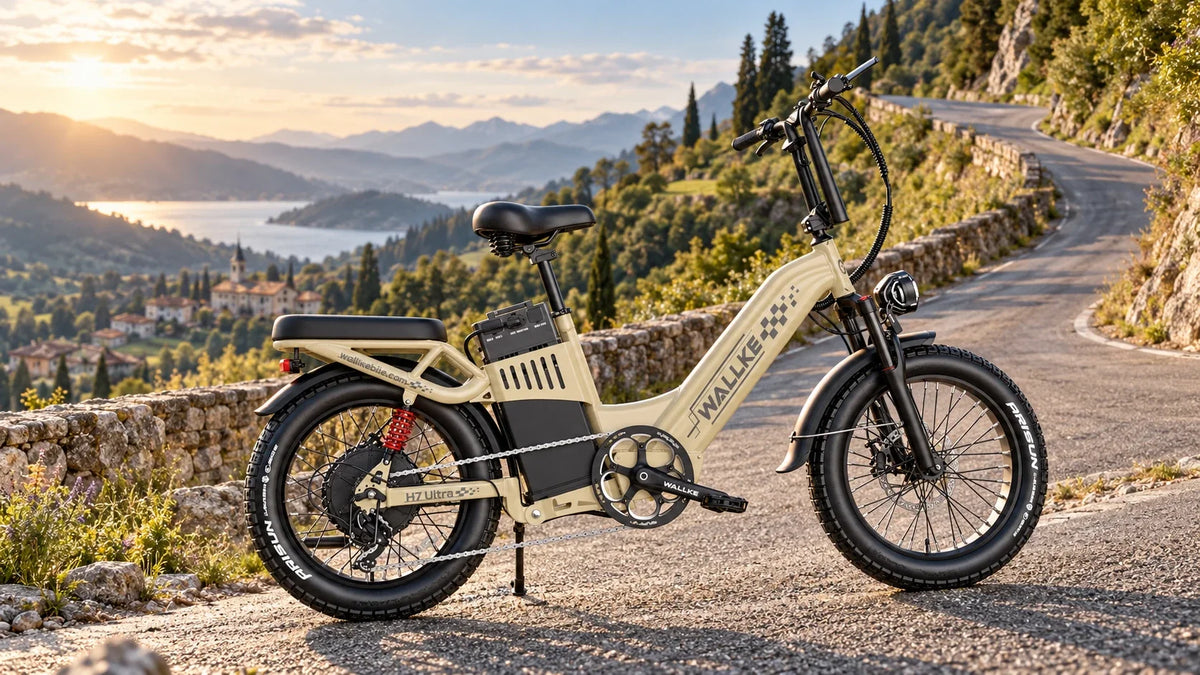
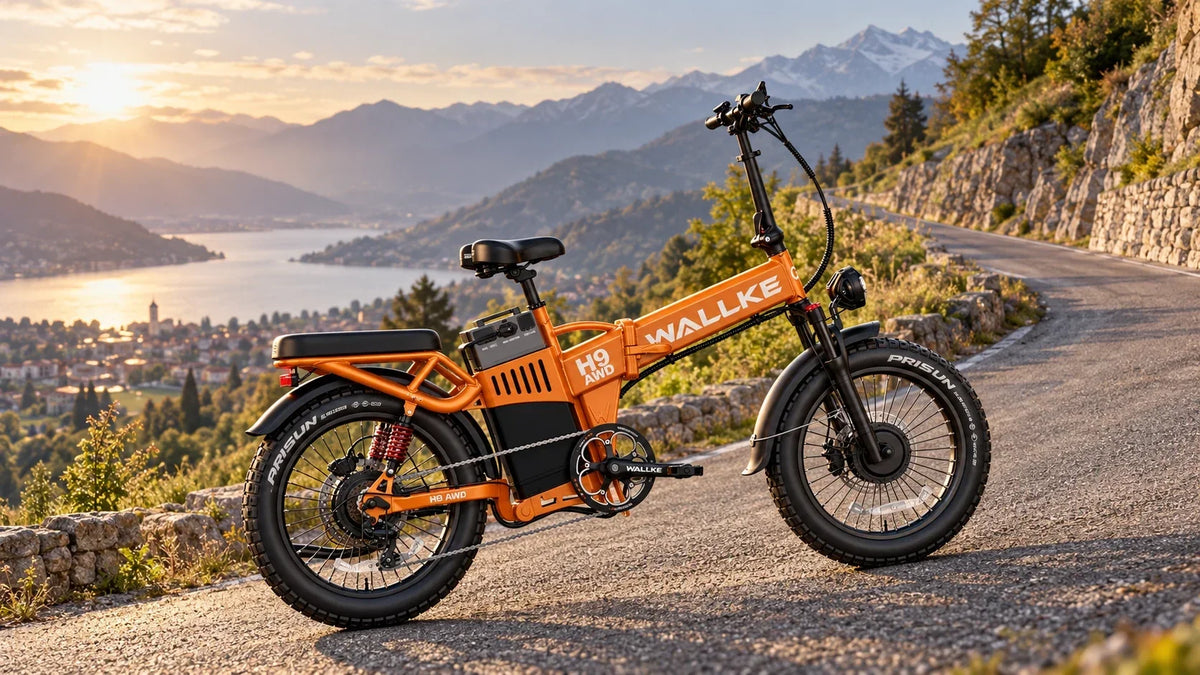
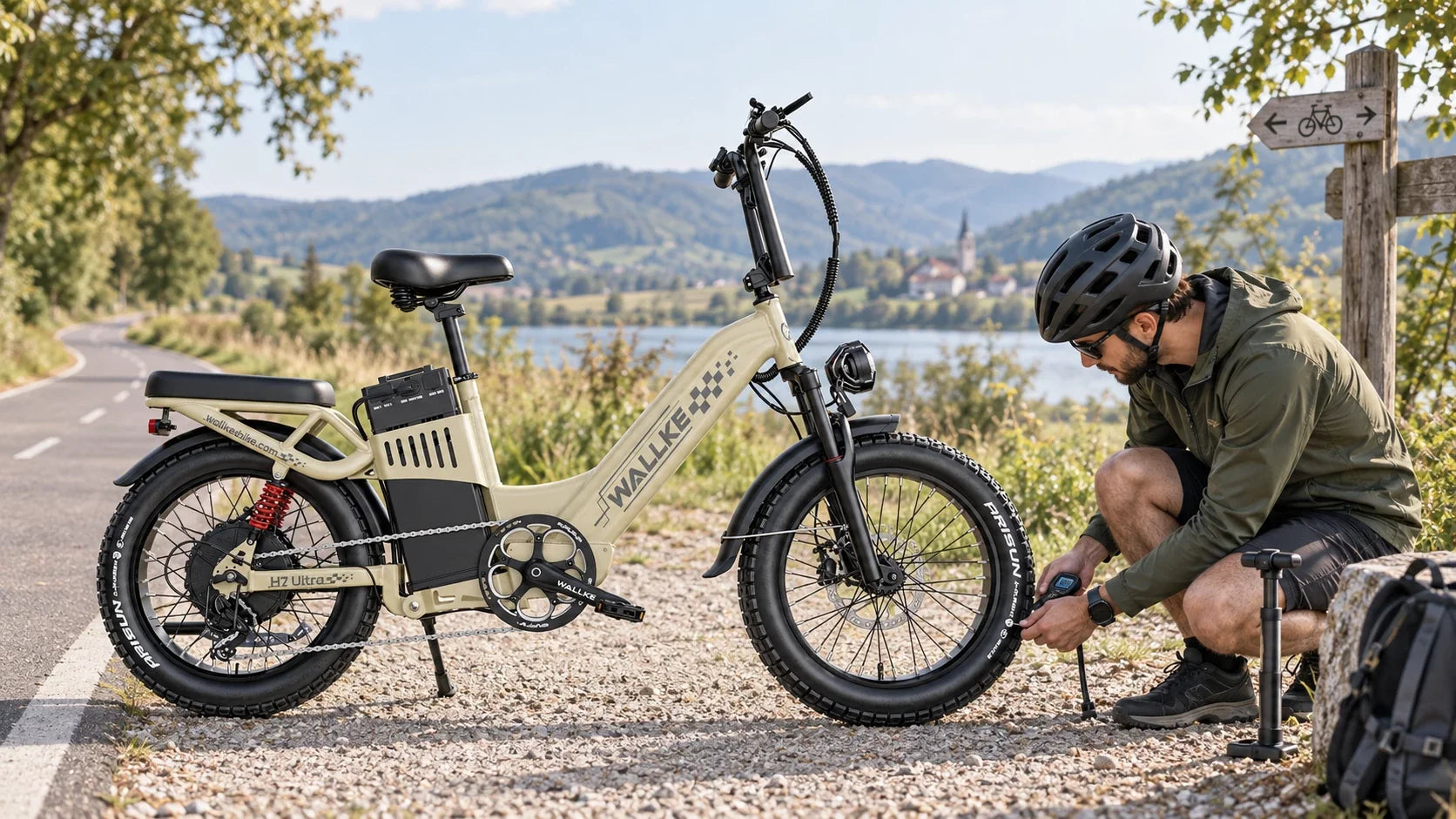
The current product pages for the Wallke H7 AWD step-through and Wallke H9 AWD folding e-bike both state a 181 kg maximum payload. That is roughly 399 lb.
| Current EU spec | Wallke H7 AWD | Wallke H9 AWD |
|---|---|---|
| Maximum payload | 181 kg | 181 kg |
| Recommended rider height | 174–198 cm | 174–200 cm |
| Standover height | 50 cm | 70 cm |
| Net weight, current 40Ah dual-motor page | 62.7 kg | 60.3 kg |
| Tyres | 20 × 4 in | 20 × 4 in |
| Brakes | Hydraulic discs, 203 × 2.8 mm rotors | Hydraulic discs, 203 × 2.8 mm rotors |
| Current listed drive | Dual 1000W motors | Dual 1000W motors |
| Best reason to shortlist | Lower step-over for easier mounting | Folding format if storage shape matters |
On paper, both models can make sense for some riders around 300–350 lb, depending on cargo and fit. They are not a valid recommendation for a rider who already weighs 400 lb, because the rider alone would be at or above the stated payload.
The H7 is the more obvious choice if a lower step-over matters. Its published 50 cm standover is substantially lower than the H9’s 70 cm figure.
The H9 folds, which can help with storage shape. But at a listed 60.3 kg in the current configuration, “folding” should not be confused with “easy to carry”.
Do heavier riders need dual motors?
Not automatically.
Dual motors can provide more available drive force and traction, which may be useful on steep or loose surfaces. They can also use more energy when both motors are engaged, and they add system complexity and weight.
If most of your riding is flat, paved commuting, a well-designed single-motor bike with enough torque, appropriate gearing and a suitable payload rating may be the better fit.
If your regular route includes steep hills, loose gravel or repeated starts under a high total load, dual-motor traction may be more relevant. Buy for the route, not for the biggest specification number.
Europe: check the road-use category before you buy
This matters because “e-bike” is used casually for vehicles that do not all fall into the same legal category.
Under EU Regulation 168/2013, pedal cycles with pedal assistance are excluded from that type-approval framework when the auxiliary motor has a maximum continuous rated power of no more than 250 W, assistance stops when the rider stops pedalling, and assistance is progressively reduced and cut off before 25 km/h.
Other configurations can fall into different categories or national requirements. A speed limit shown on a display does not, by itself, determine the vehicle category.
That is especially relevant when comparing high-output or throttle-equipped models. Wallke’s H7 AWD and H9 AWD pages currently list dual 1000W motors and a thumb throttle, so buyers should verify the exact supplied configuration and the rules for public-road, cycle-path or off-road use in their country before riding.
For the legal text, see EU Regulation 168/2013 on EUR-Lex.
Common mistakes when buying an e-bike for a heavier rider
Buying a “400 lb capacity” bike for a 400 lb rider
This leaves no meaningful room for anything else. Capacity is not the same as target rider weight.
Choosing by motor wattage first
A strong motor cannot compensate for an unsuitable payload rating, poor fit or weak braking setup.
Assuming fat tyres solve every stability problem
Tyres help, but geometry, wheel condition, pressure, suspension, surface and rider technique all matter.
Ignoring the e-bike’s own weight
A 60 kg e-bike is a very different ownership proposition from a 25 kg commuter. Think about storage and recovery before buying.
Using advertised range as a guarantee
Range claims are reference points, not promises. Heavier loads, hills, cold weather and higher assist levels can all reduce distance.
Assuming “25 km/h” automatically means standard pedelec legality
European vehicle classification also depends on factors such as maximum continuous rated power and how assistance or throttle operation works.
A practical buying checklist
- Convert your body weight to kilograms. European specifications usually use kg.
- Add normal carried load. Include clothing, bag, lock, tools and regular cargo.
- Check the official maximum payload. Do not rely on reseller shorthand.
- Leave usable headroom. Avoid planning to sit permanently at the stated maximum.
- Check height and standover. Make sure you can mount, stop and steer comfortably.
- Inspect braking, wheels and tyres. These matter as much as motor power.
- Match the drive system to your hills. Do not overbuy power for flat urban use.
- Compare battery watt-hours. Then adjust your expectations for total weight and terrain.
- Check the bike’s own weight. Make sure you can store and transport it.
- Verify the legal configuration. Check the exact version and the rules where you intend to ride.
If you are deciding between Wallke’s current models, the side-by-side e-bike comparison tool is the fastest way to check the main specifications before opening each product page.
So, what is the best electric bike for heavy riders?
The best choice is not the bike with the loudest power claim. It is the one that gives your real body weight enough payload headroom, fits your proportions, stops confidently, works on your hills and remains practical to own.
For a 300 lb rider, there are meaningful options. At 350 lb, the shortlist gets narrower and load margin deserves closer attention. At 400 lb or 500 lb, you need a manufacturer-rated capacity that is genuinely above the rider’s own weight—not a near match.
Wallke’s current H7 AWD and H9 AWD list a 181 kg maximum payload. That makes them relevant to some heavier riders, but not every heavier rider. The H7’s lower step-over may suit riders who prioritise easier mounting. The H9’s folding frame may suit storage needs. Neither should be presented as a 400 lb-rider solution when the stated payload itself is about 399 lb.
That distinction is more useful than calling any one bike “best” for everyone.
FAQ
Can a 300 lb person ride an e-bike?
Yes, if the bike’s stated maximum payload comfortably exceeds the rider’s weight plus clothing, luggage and other carried items. A 300 lb rider is about 136 kg. Do not choose a bike whose limit is only slightly above that figure.
What is the best electric bike for a 300-pound person?
There is no single best model for every 300 lb rider. Start with a payload rating above 136 kg, then check rider-height fit, frame access, brakes, wheels, tyres, battery capacity and hill performance. On paper, Wallke H7 AWD and H9 AWD list a 181 kg maximum payload, leaving roughly 45 kg of theoretical load margin before cargo for a 300 lb rider.
What should I look for in an electric bike for a 350 lb person?
A 350 lb rider is about 159 kg, so payload headroom becomes especially important. Look for a manufacturer-stated payload clearly above your total carried load, strong braking hardware, suitable wheels and tyres, correct rider fit and enough battery for your terrain. A 181 kg payload leaves only about 22 kg of theoretical margin before cargo.
What is the best electric bike for a 400-pound person?
A rider who weighs 400 lb is about 181.4 kg. A bike rated to 181 kg is therefore not an appropriate match for that rider because the rider alone is already at or slightly above the stated limit. Look for a model with a materially higher manufacturer-rated payload rather than treating a 400 lb label as close enough.
What e-bike can hold 500 pounds?
Only consider an e-bike whose manufacturer explicitly states a payload of at least 500 lb (about 227 kg), preferably with additional margin for cargo. Do not infer a 500 lb capacity from motor wattage, fat tyres or a large-looking frame.
Does a more powerful motor make an e-bike better for heavier riders?
Not by itself. Motor output can help with acceleration and climbing, but payload rating, braking, wheel strength, tyre load capability, gearing, cooling and rider fit are equally important. In Europe, motor configuration can also affect the vehicle’s legal category.
Do heavier riders get less e-bike range?
Often, yes, especially on routes with frequent acceleration or climbing. More total mass requires more energy to accelerate and climb. Actual range also depends on assistance level, speed, wind, temperature, tyre pressure, terrain and drive mode.
Are fat tyres better for heavy riders?
They can improve comfort and stability on rough surfaces when used within the tyre maker’s approved pressure and load limits, but fat tyres are not proof of a high payload rating. They also add rolling resistance and weight.
Is a step-through frame useful for heavier riders?
It can be, particularly if mounting, stopping or hip mobility is a concern. What matters is the manufacturer’s stated payload and the complete frame design. A low step-over should be treated as an accessibility feature, not as proof of structural strength.
Are high-power e-bikes legal on public roads in Europe?
There is no single rule that makes every high-power e-bike equivalent to a standard pedelec. Under EU Regulation 168/2013, pedal-assisted cycles with a maximum continuous rated auxiliary motor power of 250 W or less, assistance that stops when pedalling stops, and assistance progressively cut off before 25 km/h are excluded from that type-approval framework. Other configurations can fall into different categories and national requirements. Check the exact supplied bike configuration and the rules where you ride.
Leave a comment