



Quick answer: the longest-range e-bikes in 2026 include specialist machines with manufacturer claims reaching 200 or even 300 miles. But those headline figures are not produced under one standard test, and they are not guaranteed real-world distances.
For most European buyers, the better question is: which e-bike gives me enough repeatable range without becoming too heavy, too expensive or impractical for the way I ride?
If you are comparing current Wallke electric bikes in Europe, start with battery energy, drive mode and the manufacturer's published range reference. Then compare those numbers with your own route, speed, terrain and legal requirements.
What eBike Has the Longest Range in 2026?
If the question is purely about the largest published number, specialist expedition e-bikes sit at the top end of the market. Optibike currently advertises the R22T Everest with a maximum range of up to 300 miles from a 3,260Wh dual-battery system.
That number needs context. Optibike publishes it as a manufacturer maximum, not an independent standardised test result. Its stated maximum-range references use moderate pedalling and controlled riding conditions.
Other brands also publish very large numbers. Fiido lists up to 347 km for a Titan configuration using an extender setup, while Aniioki publishes 170–210 miles with pedal assist for its AQ177 Pro Max Dual Motor.
These examples prove that 100-, 200- and 300-mile claims exist. They do not prove that one brand will travel farther than another on your route.
Current Long-Range eBike Claims: What the Numbers Actually Tell You
Important: the figures below are manufacturer-published specifications or range references checked in September 2026. They were not produced under one independent test protocol, so this is a buying comparison rather than a laboratory ranking.
| Model | Battery | Published range reference | What matters for buyers |
|---|---|---|---|
| Wallke H9 AWD | 48V 40Ah / 1,920Wh | 70 km single drive; 50 km dual drive | Folding step-over frame, selectable AWD use, full suspension and 20×4-inch tyres. Wallke publishes separate single- and dual-drive references rather than one headline number. |
| Wallke H7 AWD | 48V 40Ah / 1,920Wh | 70 km single drive; 50 km dual drive | Step-through frame, dual-drive hardware, full suspension and a 181 kg published payload. Better suited to riders who prioritise easier mounting over a folding frame. |
| Optibike R22T Everest | 3,260Wh dual battery | Up to 300 miles / 483 km | A specialist expedition platform with a best-case manufacturer maximum. It is not directly comparable with an everyday EU e-bike tested under different conditions. |
| Fiido Titan | 696Wh per battery; expandable battery setup | 115 km standard; up to 347 km with extender configuration | The largest figure depends on carrying additional batteries, so cost, weight and charging logistics matter. |
| Aniioki AQ177 Pro Max Dual Motor | 52V 70Ah / 3,640Wh | 170–210 miles with PAS; 70–90 miles without PAS | The brand publishes very different figures depending on rider input. The high-power configuration also needs separate road-use checks in Europe. |
The table highlights an important difference in how brands communicate range.
Some brands lead with one maximum number. Wallke's current European H7 and H9 pages instead publish separate references for single-drive and dual-drive use. That makes the trade-off easier to see: using AWD for additional traction can reduce the distance available from the same battery.
Wallke is therefore not presented here as the 300-mile record holder. Its stronger case for many European buyers is different: a large 1,920Wh battery, selectable drive behaviour, fat tyres, suspension and Europe-specific product pages that show the supplied 40Ah configuration clearly.
Where Wallke Fits: A Practical Long-Range Choice for European Buyers
If your only goal is to chase the biggest advertised number, there are specialist bikes with higher manufacturer claims than the current Wallke H7 and H9.
But most buyers are not planning a controlled 300-mile range attempt. They need a bike that fits real use: commuting, weekend rides, hills, mixed surfaces, cargo, storage and occasional longer trips.
Why compare Wallke H7 and H9?
- 1,920Wh nominal battery energy: both current European product pages list 48V 40Ah batteries.
- Separate drive-mode range references: 70 km in single-drive mode and 50 km in dual-drive mode are currently published on both product pages.
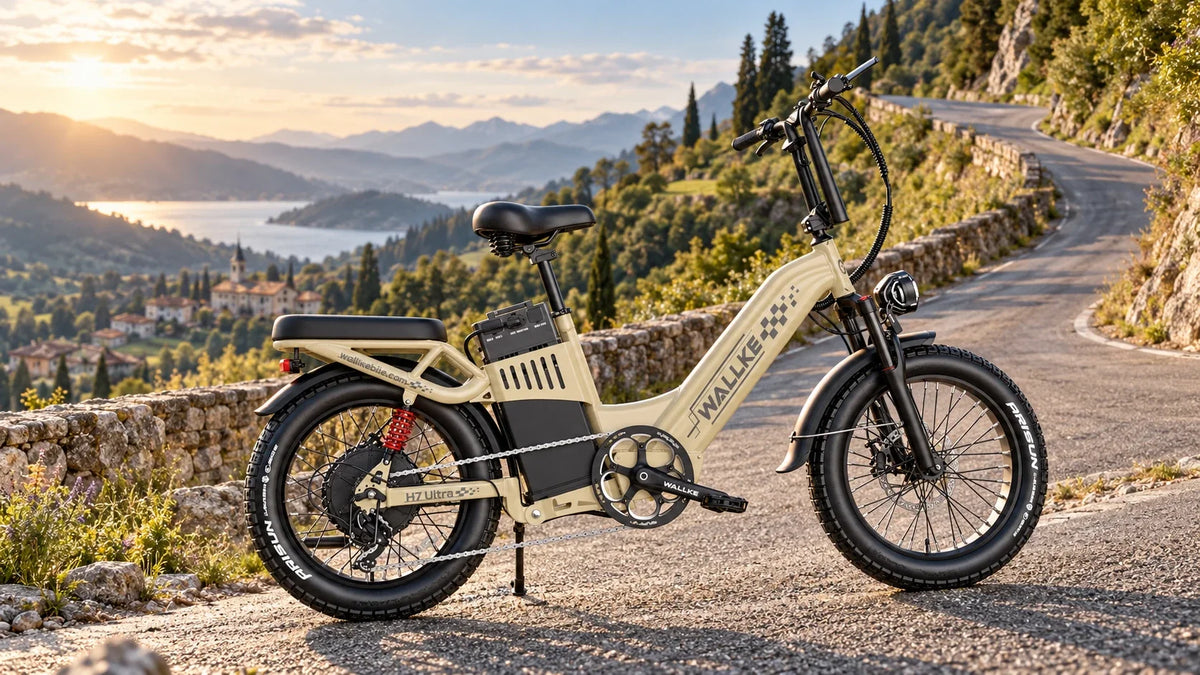
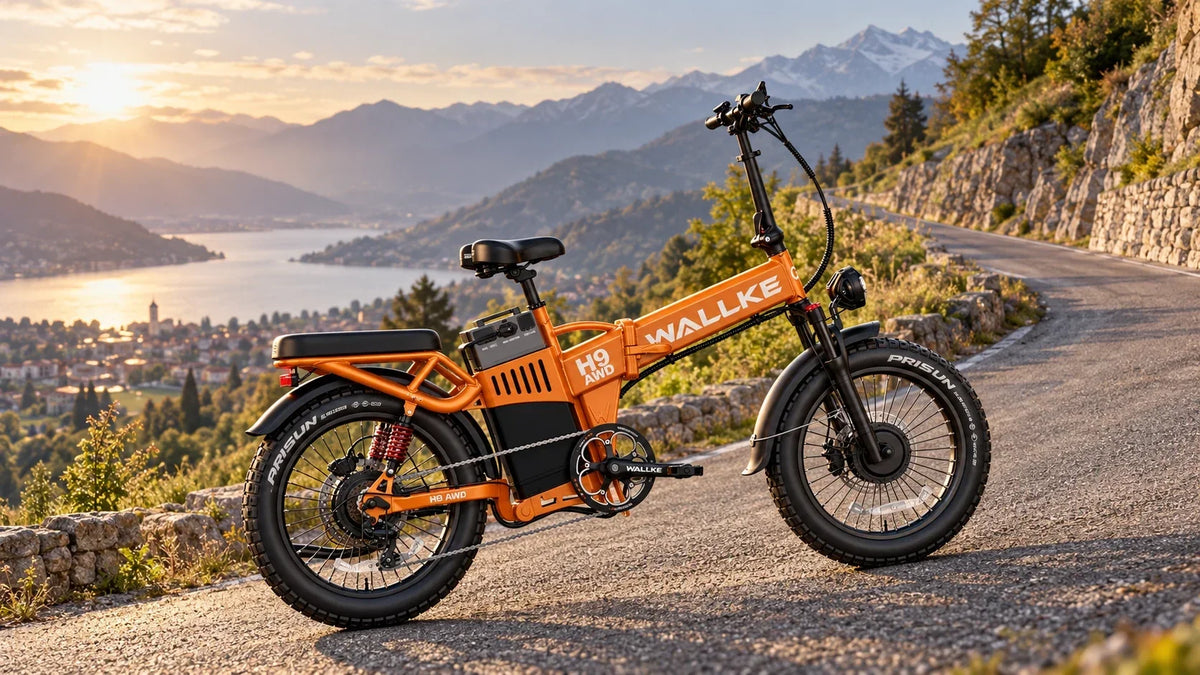
- Two frame choices: the H7 AWD uses a step-through layout, while the H9 AWD uses a folding step-over frame.
- Mixed-surface hardware: both current EU models list full suspension and 20×4-inch fat tyres.
- High published payload: both current product pages list a maximum payload of 181 kg.
- EU storefront: specifications, availability and pricing can be checked on the European site rather than inferred from a US model page.
The trade-off is weight. The current H9 page lists a net weight of about 60.3 kg, while the H7 page lists about 62.7 kg. These are not lightweight commuter bikes, and the folding H9 should not be assumed to be easy to carry upstairs simply because it folds.
That is the type of trade-off a long-range buyer should see before purchase. More battery, AWD hardware, suspension and fat tyres can add capability, but they also add mass.
For current battery and configuration options, use the Wallke 48V electric bike collection as a comparison hub, then confirm the exact live product page before ordering.
The Range Number to Understand First: Battery Watt-Hours
Voltage alone does not tell you range. Amp-hours alone do not tell you range either.
A better starting point is nominal battery energy:
For the current Wallke H7 AWD and H9 AWD:
That does not mean every nominal watt-hour is available at the motor, and it does not guarantee a fixed number of kilometres. It gives you a useful capacity figure for comparison.
Range then depends on energy consumption. A simple way to think about it is:
The difficult part is that consumption changes every ride.
Why Real-World eBike Range Can Be Much Lower Than the Headline
This is why owner discussions often focus on “real-world range” rather than the biggest number on a product page.
1. Pedal-assist level
Low assistance asks the rider to contribute more. Higher assistance asks the battery to contribute more. The same bike can therefore return very different distances for two riders.
2. Speed
Higher speed usually increases energy demand, especially as aerodynamic drag rises. A maximum range obtained at a relaxed pace should not be treated as the expected result at a much higher cruising speed.
3. Hills
Long or steep climbs require more energy. They also encourage riders to choose higher assistance or engage both motors where available.
4. Rider and cargo weight
Total mass matters during acceleration and climbing. Touring luggage, tools, child seats and cargo should be included when you estimate practical range.
5. Tyres and pressure
Fat tyres can add grip and comfort on rough surfaces, but tyre design, pressure and surface all affect rolling resistance.
6. Temperature
Cold conditions can reduce the battery performance riders experience. Do not assume a mild-weather range figure will be repeated in winter.
7. Single drive vs dual drive
This matters particularly on AWD e-bikes. Using both motors can increase battery consumption when the extra motor is being used to provide more traction or power.
Wallke's current H7 and H9 specifications make this visible by publishing separate 70 km single-drive and 50 km dual-drive references. That does not predict every owner's result, but it is more useful than pretending motor mode has no effect.
Throttle-Only Range vs Pedal-Assist Range
A long-range e-bike with a throttle can sound like the best of both worlds: less pedalling and more distance.
In practice, those goals work against each other. If the motor supplies more of the propulsion, the battery must supply more of the energy.
If throttle-only range matters to you, compare tests that were actually conducted in throttle-only or non-pedal-assist mode. Do not compare that result with a manufacturer's best-case low-assist figure.
Also check the exact European configuration. A throttle-equipped or high-power configuration may be classified differently from an ordinary pedelec.
European Buyers: Range Does Not Decide Road Legality
Europe is not one single road-use rulebook, and range itself does not determine the legal category.
At EU level, the familiar pedal-assisted cycle exclusion from motor-vehicle type approval applies to pedal-assist cycles with a maximum continuous rated auxiliary motor power of no more than 250W, where assistance stops when the rider stops pedalling and is progressively reduced and cut off before 25 km/h.
That is why a 48V battery, a large Wh figure, a throttle or dual-motor hardware should not be treated as a complete legal answer by itself.
Before road use, check the exact supplied version, continuous rated power, assistance behaviour, speed configuration and any registration, insurance or access rules that apply in your country.
How to Choose the Longest-Range eBike That Actually Fits Your Life
1. Start with your real route
If your longest normal ride is 60–80 km, a huge expedition battery may create more weight and cost than value.
2. Keep a battery reserve
Do not plan to arrive at 0%. Weather, hills, diversions, cold conditions and battery ageing can all reduce your margin.
3. Compare Wh before headline miles
Large range numbers are easier to judge when the brand also publishes voltage, Ah and Wh.
4. Check whether the range is PAS, throttle or mixed use
A 100-mile low-assist claim and a 100-mile throttle-only result are not the same achievement.
5. Check total bike weight
Very large batteries and AWD systems add mass. A bike can fold and still be impractical to lift.
6. Decide whether AWD is worth the energy trade-off
For hills, loose surfaces and traction-limited riding, dual drive can be useful. For a long flat ride, a selectable single-drive mode may be the more range-focused choice.
7. Match the frame to your body and storage
The Wallke H7 AWD is the more obvious choice if easier mounting matters. The H9 AWD is the more relevant comparison if a folding frame matters. Neither choice should be made on battery size alone.
8. Match the bike to the terrain
If your long-distance riding includes gravel, rough tracks or loose surfaces, read the Wallke off-road e-bike buying guide for Europe before choosing solely by range.
9. Check charging and replacement batteries
A larger battery can take longer to recharge. For touring, charger practicality and replacement battery availability can matter as much as the maximum range claim.
What About the Cheapest Long-Range Electric Bike?
Searching for the cheapest long-range electric bike is reasonable, but unusually ambitious range claims at unusually low prices deserve closer scrutiny.
Battery packs are a major part of e-bike cost. The frame, motor, controller, brakes, suspension, tyres, charger, warranty and after-sales support still have to be paid for.
Instead of buying the cheapest bike with the largest number, compare:
- battery Wh;
- range test mode and conditions;
- replacement battery availability;
- charging time;
- brakes and tyres;
- bike weight and payload;
- rider fit;
- warranty and service support.
So, Is a 100-Mile eBike Realistic?
Yes. Current manufacturers publish e-bikes with maximum claims above 100 miles.
But “100 miles” only becomes useful when the test conditions are clear. Ask:
- How many Wh are available?
- Which assist level was used?
- Was the rider pedalling continuously?
- What was the speed?
- Was the terrain flat?
- How much did the rider and cargo weigh?
- Was one motor or two being used?
If those details are missing, treat 100 miles as a marketing reference rather than a planning guarantee.
What About 200 or 300 Miles?
At 200–300 miles, you are comparing specialist long-distance systems, not ordinary everyday e-bikes.
The trade-offs become much larger:
- more battery mass;
- more purchase cost;
- longer or more complex charging;
- harder transport and storage;
- greater dependence on specific test conditions;
- more need to check the legal classification of the supplied configuration.
For many European riders, a high-capacity bike that comfortably covers the real route, plus a sensible charging plan, is more useful than chasing the largest theoretical number.
Final Verdict: The Best Long-Range eBike Is the One You Can Use Repeatedly
The longest range eBike and the best long-range eBike for your life are not always the same product.
Specialist competitors can publish 200- or 300-mile maximums. Those numbers are useful for understanding the outer edge of the market.
For Wallke buyers in Europe, the current H7 AWD and H9 AWD offer a different proposition: 1,920Wh batteries, selectable drive use, fat tyres, full suspension and two distinct frame formats, with range references published separately for single- and dual-drive modes.
If you need easier mounting, start with the Wallke H7 AWD. If you prefer a folding step-over frame, compare the Wallke H9 AWD. If you are still deciding by battery and configuration, browse the current 48V Wallke e-bike collection.
Whichever bike you choose, buy for a repeatable distance with reserve. That is more useful than buying the largest number on the page.
FAQ
What is the longest range eBike available in 2026?
At the extreme end of the market, specialist models such as the Optibike R22T Everest are advertised by their manufacturers with maximum ranges of up to 300 miles. That is a manufacturer maximum, not a guaranteed real-world result. For most buyers, battery Wh, test conditions, bike weight and the distance they can repeat on their own route matter more than the record claim.
Is there an electric bike with a 100-mile range?
Yes. Several current e-bikes have manufacturer-published maximums above 100 miles. But a 100-mile pedal-assist claim should not be treated as a guaranteed 100-mile ride or as a 100-mile throttle-only result. Compare battery Wh and the published test conditions before buying.
What eBike has a 200-mile range?
Optibike's R22T Everest is one current example above that threshold on paper, with a manufacturer-published maximum of up to 300 miles. Aniioki also publishes a 170–210-mile pedal-assist range for the AQ177 Pro Max Dual Motor. These figures come from different brand test methods and should not be treated as directly comparable independent results.
Which eBike has an 80- or 90-mile range?
There are current models with manufacturer claims in this range, especially when the brand separates pedal-assist and non-pedal-assist modes. The important question is not whether 80 or 90 miles appears in the specification, but whether the test mode resembles the way you actually plan to ride.
What is the longest range eBike with throttle only?
Throttle-only range is normally a different number from a brand's best pedal-assist claim because the rider contributes less energy. If throttle-only distance matters, compare data that was actually produced in throttle-only or non-pedal-assist mode and check how that configuration is classified where you ride.
How much battery do I need for a 100-mile eBike?
There is no single battery size that guarantees 100 miles. Nominal battery energy in Wh is the starting point, but consumption changes with speed, gradients, rider and cargo weight, assist level, tyres, temperature and motor use.
Are Wallke H7 and H9 long-range eBikes?
The current Wallke Europe H7 AWD and H9 AWD product pages list 48V 40Ah batteries, equal to 1,920Wh nominal battery energy. Wallke currently publishes separate range references of 70 km in single-drive mode and 50 km in dual-drive mode. Those figures are not 100-mile claims, but the separate drive-mode references are useful when judging how AWD use affects practical range.
Is a dual-motor eBike better for long range?
Not automatically. Dual motors can improve traction and performance on demanding terrain, but using both motors can increase battery consumption when they are being used to deliver additional traction or power. A selectable single-drive mode can therefore be useful when range matters more than maximum traction.
Are long-range eBikes legal in Europe?
Range and battery capacity do not determine the legal category by themselves. At EU level, the familiar pedelec exclusion from motor-vehicle type approval applies to pedal-assisted cycles with an auxiliary motor rated at no more than 250W continuous, with assistance stopping when pedalling stops and progressively cutting off before 25 km/h. Other configurations can fall under different rules, and national requirements may also apply.
What should I check before buying the cheapest long-range eBike?
Check battery Wh, the conditions behind the range claim, replacement battery availability, charging time, brakes, total weight, rider fit, payload, warranty and service support. A low price is not good value if the claimed distance is unrealistic or the battery is difficult to replace.
Leave a comment