



An electric hunting bike is not simply the most powerful e-bike you can buy. For real hunting access, the important questions are quieter and more practical: Can it handle the track you actually use? Can it carry your kit without becoming difficult to control? Will the battery cover the full return route? Can you repair a puncture in the field? And are you allowed to ride that configuration where you plan to hunt?
If your route includes gravel, forestry tracks, mud, loose climbs or rough estate roads, start by comparing off-road e-bikes and fat tyre e-bikes rather than shopping by motor wattage alone. If you are still deciding what type of e-bike fits your broader use, see Wallke's electric bikes for adults first.
What Is an Electric Hunting Bike?
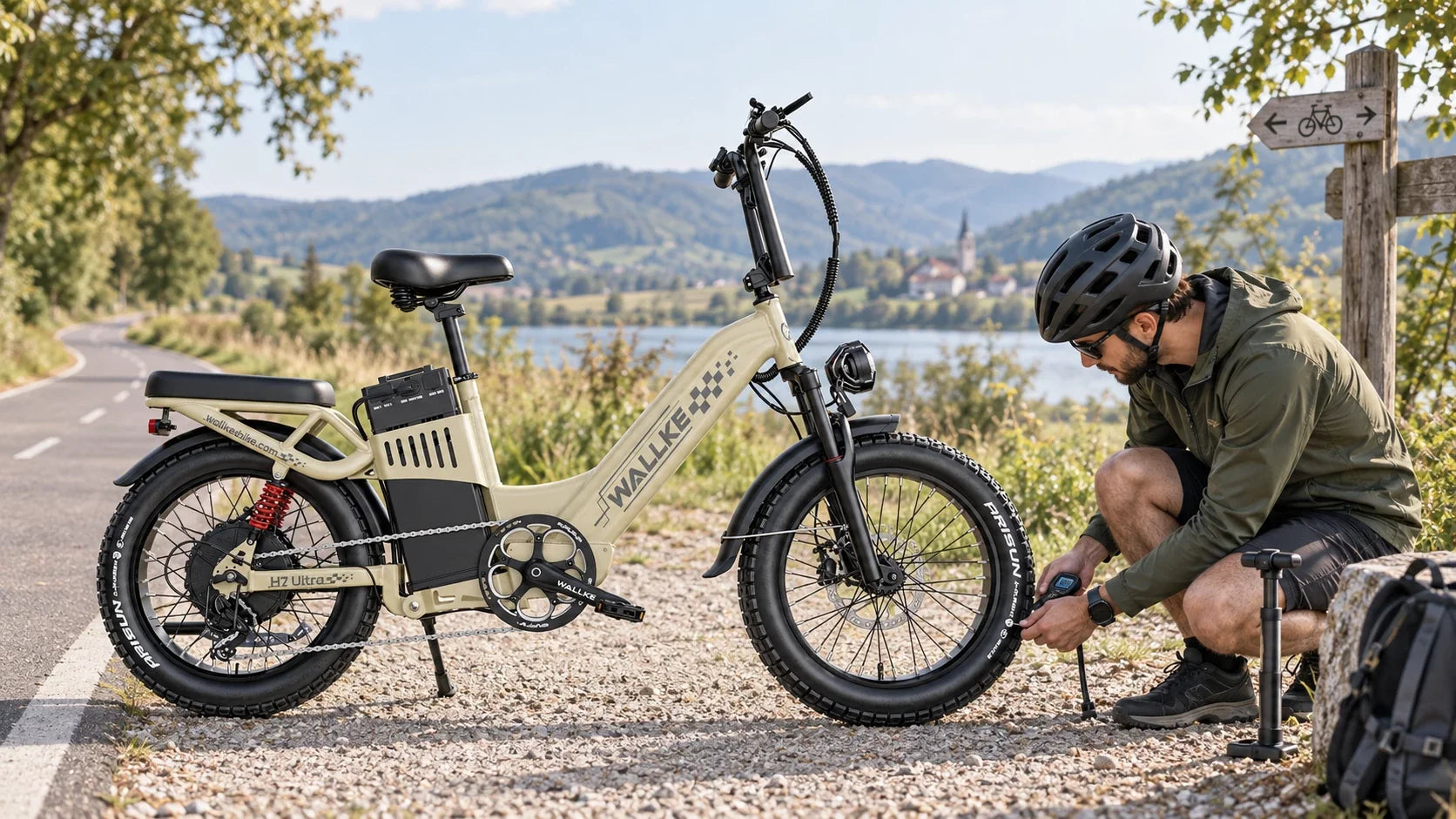
"Electric hunting bike" describes a use case more than a single technical category. It is usually an e-bike adapted to carry a rider and equipment over rougher ground, often with wide tyres, a strong frame, suspension, racks or trailer compatibility.
Some are rear-hub bikes. Some use a mid-drive. Others use front and rear hub motors for all-wheel drive. Frame styles also vary. You will find step-through, step-over and folding designs.
That matters because two bikes can both be sold as rugged or off-road models but feel very different once you add a backpack, optics, wet clothing, tools, food, a trailer or other hunting gear.
It is also worth separating an electric hunting bike from an electric motorcycle. In Europe, power, assistance behaviour and vehicle classification can change what rules apply. A machine that looks like a bicycle is not automatically treated as a normal pedal cycle.
Are E-Bikes Worth It for Hunting?
They can be. The strongest case is access and logistics.
- Less effort over long tracks: assistance can reduce fatigue before the part of the day that actually matters.
- More compact than an ATV or larger motor vehicle: useful where a legal cycle-width route exists and vehicle access is limited.
- Lower noise: an e-bike is generally quieter than a combustion-engine vehicle, although tyres, drivetrain, brakes and the motor still make sound.
- Cargo flexibility: a rack, panniers or compatible trailer can help carry equipment.
- Useful on mixed terrain: the right tyre, suspension and motor setup can make gravel, dirt and broken tracks more manageable.
But there are trade-offs. Hunting-oriented fat tyre e-bikes can be heavy. Soft ground, cold weather, steep climbing and a loaded trailer can reduce range. Wide tyres increase rolling resistance. A powerful dual-motor setup can consume battery faster. And if the battery is depleted far from the vehicle, you still have to move the bike under your own power.
So the better question is not "Are e-bikes good for hunting?" It is "Does an e-bike solve the access problem I actually have?"
How to Choose an Electric Hunting Bike
| Buying factor | Why it matters for hunting | What to check |
|---|---|---|
| Terrain | Loose climbs, mud and broken tracks need different handling from hard-packed estate roads. | Tyre width and tread, gearing, suspension, low-speed control and ground clearance. |
| Battery | The return trip matters more than the headline maximum. | Battery watt-hours, cold-weather use, elevation, cargo weight and assistance level. |
| Motor layout | Mid-drive, rear hub and AWD systems behave differently on hills and loose ground. | Climbing style, traction, maintenance, weight and legal classification. |
| Payload | Rider, clothing, rack, bags and gear all count. | Published bike payload and separate limits for racks or trailers. |
| Brakes | More mass means more work for the brakes, especially downhill. | Brake type, rotor size, pad availability and condition. |
| Frame fit | Mounting a tall bike can be awkward when wearing boots or carrying a pack. | Standover height, rider-height guidance and loaded mounting/dismounting. |
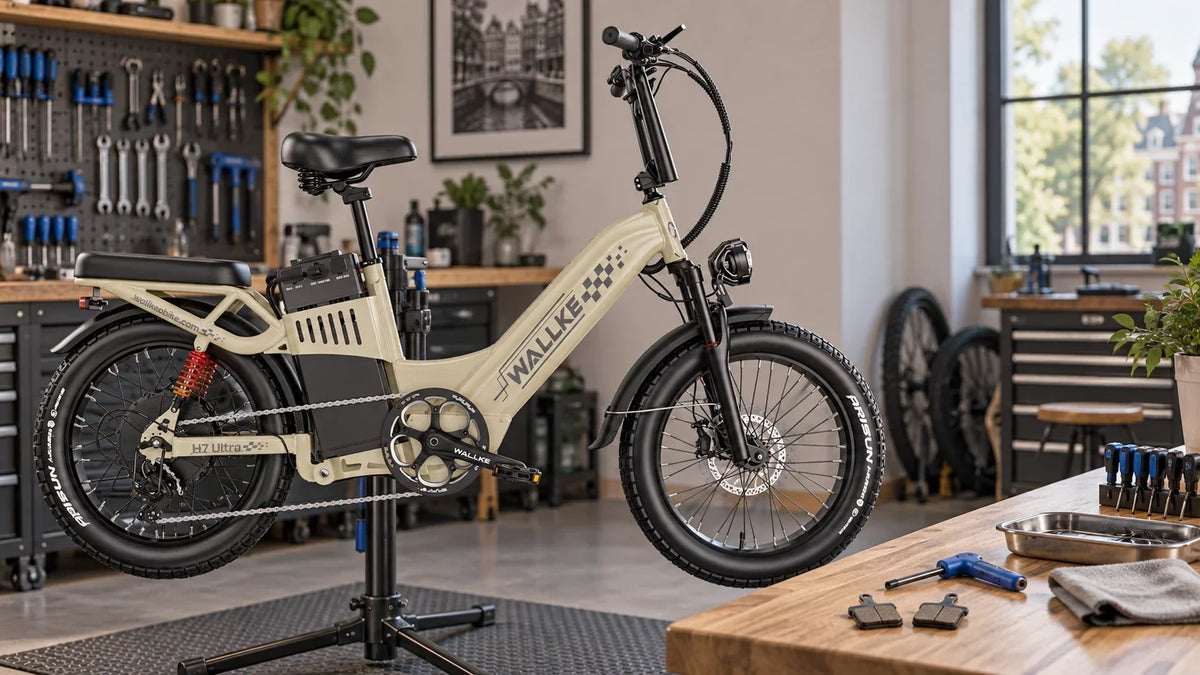
| Serviceability | Remote use punishes proprietary or hard-to-source parts. | Tyres, tubes, brake pads, drivetrain parts, connectors and dealer/support access. |
| Legal access | A capable bike is useless if it is not allowed on the route. | Vehicle class, national rules, trail/forest rules, landowner permission and hunting rules. |
Motor Choice: Mid-Drive, Rear Hub or Dual Motor?
Mid-drive
A mid-drive powers the bike through the bicycle drivetrain. That lets the motor benefit from the bike's gears, which can work well on sustained steep climbs and at low speeds.
The trade-off is greater load through the chain, cassette and derailleur. If you ride in mud or carry heavy loads, drivetrain maintenance matters.
Rear hub
A rear-hub motor is mechanically straightforward and can suit moderate hills, forest roads and mixed-use riding. It does not use the bicycle's gears to multiply motor torque in the same way as a mid-drive.
For many hunters, a well-set-up single-motor bike is enough. It is usually a mistake to assume that a higher wattage figure automatically gives better field control.
Dual motor / AWD
A dual motor hunting e-bike drives both wheels. The main advantage is traction when the surface is loose, the slope is steep, or a loaded bike struggles to keep one tyre hooked up.
AWD also has costs: more weight, more electrical demand and more components. Wallke's current H7 AWD and H9 AWD pages, for example, publish separate range references for single-drive and dual-drive use. The 48V/40Ah versions list 70 km in single-drive mode and 50 km in dual-drive mode. Those are manufacturer reference figures, not independent hunting-range tests.
For a deeper comparison of where AWD helps and where it does not, see the AWD e-bike for hills guide.
Battery Range: Plan the Return Route, Not the Advertised Maximum
Range is one of the most searched questions around electric hunting bikes, but a single "typical range" is not very useful.
Start with battery energy in watt-hours (Wh). A 48V 40Ah battery, for example, stores a nominal 1,920Wh. That tells you more about stored energy than voltage alone.
Then look at the conditions that increase consumption:
- long or repeated climbs;
- soft ground, mud, sand or snow;
- low tyre pressure;
- cold temperatures;
- high assistance levels;
- dual-motor use;
- rider plus cargo weight;
- a loaded trailer;
- stop-start riding rather than steady cruising.
Do not plan a remote route that requires the battery to reproduce a best-case published figure. Build the trip around the complete out-and-back distance and keep a practical reserve.
If range is a major buying criterion, Wallke's long-range e-bike guide explains why battery size, riding mode and test conditions matter more than a single headline number. You can also compare current 48V electric bikes by battery capacity and drive configuration.
Fat Tyres: Useful, but Not Magic
Fat tyres are common on electric hunting bikes because the extra tyre volume can improve stability and flotation on gravel, loose soil and some softer surfaces.
They can also add comfort at lower pressures. That is useful on broken access tracks where small bumps and washboard surfaces would otherwise fatigue the rider.
But a 4-inch tyre does not make every trail rideable. Tread pattern, pressure, rider technique and surface conditions still matter. Very soft mud can stop a heavy e-bike. Wet roots and rock can still be slippery. Wide tyres also add drag and rotational weight.
If loose and mixed surfaces are a regular part of your route, compare the current Wallke fat tyre e-bike collection rather than choosing a narrow-tyre commuter and trying to turn it into a hunting platform later.
Electric Hunting Bike With a Trailer: What Changes?
A trailer can be one of the most useful additions to a hunting e-bike. It also changes the way the bike accelerates, turns and stops.
Before towing, check:
- whether the bike manufacturer permits the intended towing setup;
- the trailer's rated load;
- where the hitch attaches and whether it interferes with the axle, motor cable, derailleur or suspension;
- the bike's own payload limit;
- braking performance with the additional mass;
- tyre pressure and tyre load;
- clearance through gates, narrow tracks and tight turns.
Do not confuse a strong rear rack with a tow rating. Rack capacity and trailer compatibility are separate questions.
For hilly ground, test the complete loaded setup before taking it far from the trailhead. The climb gets attention, but the descent is often the harder test for brakes and handling.
Payload, Brakes and Frame Fit Matter More Than They Look
Hunters often focus first on motor power. In practice, load control is just as important.
The published payload should cover the rider plus everything carried on the bike. That includes clothing, backpack, water, tools, rack-mounted cargo and accessories. A trailer may have its own load rating and hitch limits.
Strong brakes are important because a hunting setup can be much heavier than a normal leisure ride. Hydraulic disc brakes are common on heavier off-road e-bikes because they can provide consistent lever feel and strong braking, but rotor and pad condition still matter.
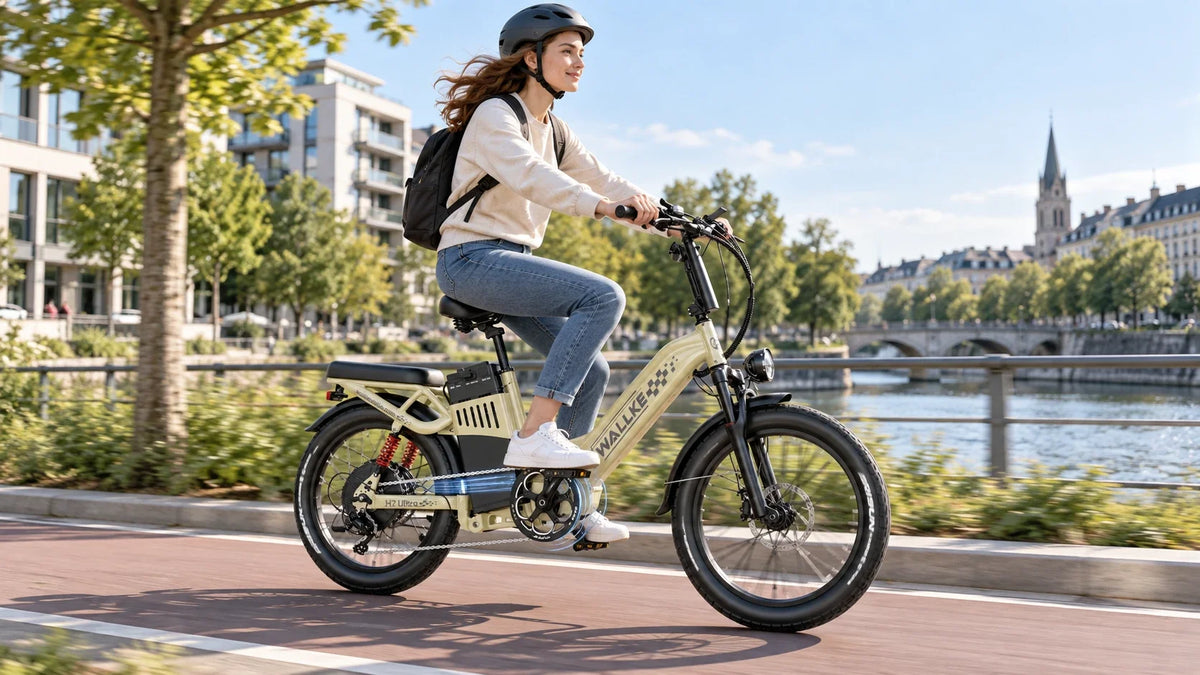
Frame shape is another practical detail. A step-through electric hunting bike can be easier to mount in boots or bulky clothing. A step-over frame can feel familiar to riders who prefer a conventional top tube. A folding frame may help with vehicle storage, but folding does not automatically mean lightweight.
Where Wallke H7 AWD and H9 AWD Fit
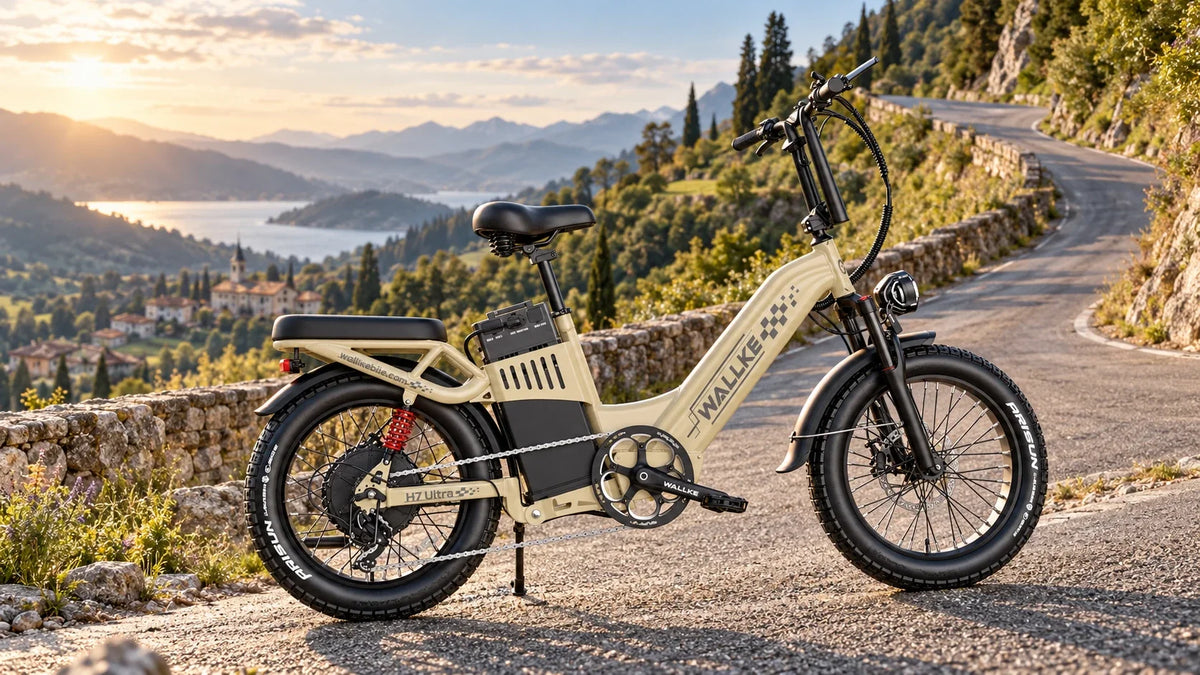
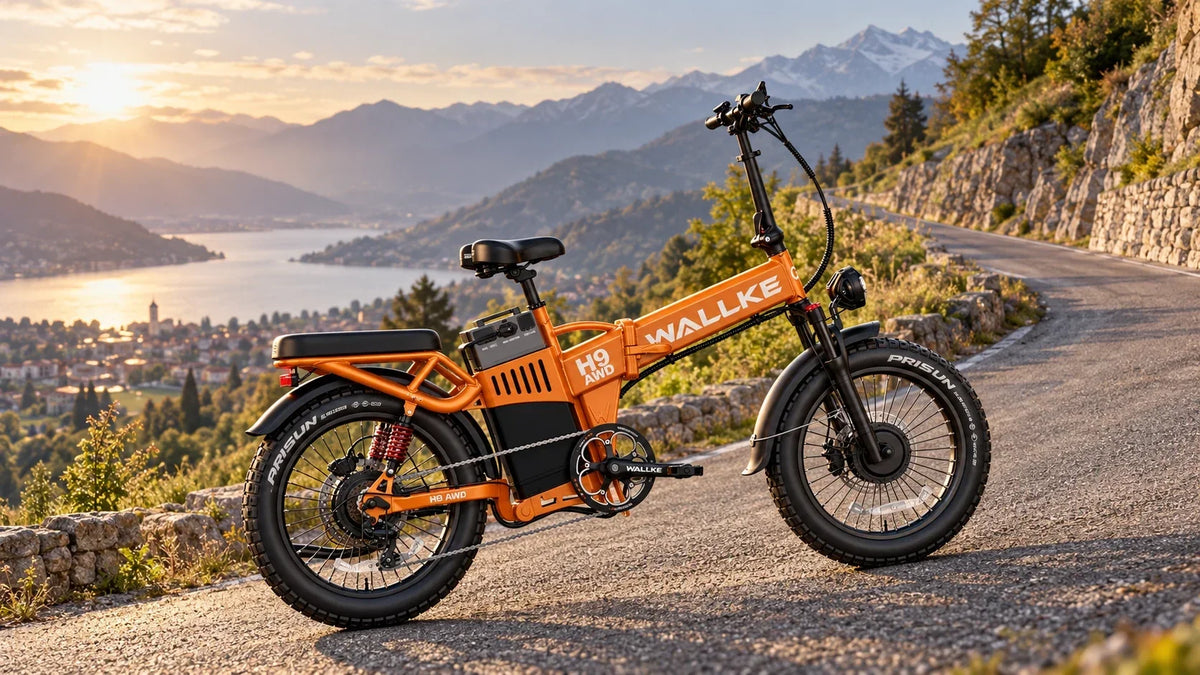
Wallke’s current H7 AWD and H9 AWD are better evaluated by their hardware than by a hunting label. The useful question is whether the frame, tyres, battery, brakes and drive layout match your route and load.
| Feature | Wallke H7 AWD | Wallke H9 AWD | Why it may matter |
|---|---|---|---|
| Frame | Step-through | Folding step-over | H7 favours easier mounting; H9 favours more compact storage. |
| Drive | Dual motor / AWD | Dual motor / AWD | Useful to compare if loose-ground traction is a priority. |
| Battery | 48V 40Ah / 1,920Wh on the current AWD page | 48V 40Ah / 1,920Wh on the current AWD page | Large stored energy, but real range still depends on load and terrain. |
| Tyres | 20 × 4 in fat tyres | 20 × 4 in fat tyres | Relevant for gravel, loose tracks and mixed surfaces. |
| Suspension | Full suspension | Full suspension | Can improve comfort and control on rougher ground. |
| Brakes | Hydraulic disc | Hydraulic disc | Important on a heavy bike and descending terrain. |
| Bike weight | 62.7 kg | 60.3 kg | Important for vehicle loading, gates, lifting and recovery if the battery is depleted. |
| Maximum payload | 181 kg | 181 kg | Rider and bike-mounted cargo must remain within the published limit. |
The Wallke H7 AWD is the more obvious starting point if mounting and dismounting with gear is a concern. The Wallke H9 AWD makes more sense if a folding frame helps with storage in a vehicle, garage or limited space.
Neither should be treated as automatically suitable for every hunting area. Check the exact configuration, legal classification and access rules before deciding where it can be used.
The weights and payload figures above are current manufacturer-published specifications, not independent field measurements. At more than 60 kg, both bikes are heavy enough that vehicle loading, stairs, gates and recovery with a flat battery deserve serious thought before purchase.
Wallke currently publishes a one-year manufacturer warranty for the original owner. For remote or rough-terrain use, also check which wear items are excluded and how replacement parts are supplied in your country.
Europe: Check the Legal Category Before You Buy
This is the part many US-focused hunting e-bike guides miss.
Within the EU, Regulation (EU) No 168/2013 excludes a familiar class of pedal-assisted cycles from L-category type approval when the auxiliary motor has a maximum continuous rated power of no more than 250W, the motor cuts off when the rider stops pedalling, and assistance is progressively reduced and finally cut off before 25 km/h.
A bike with a higher continuous motor rating, throttle behaviour outside the applicable rules or another high-power configuration may fall into a different legal category. A 25 km/h speed limit by itself does not make a high-power e-bike a standard EPAC.
The current product specifications also list a thumb throttle. Buyers should verify the exact supplied throttle behaviour, motor rating and assistance configuration rather than relying on the 25 km/h speed setting alone.
Hunting access adds another layer. National road law is only one part of the answer. Forestry roads, protected areas, private estates and hunting grounds can have their own restrictions. Landowner permission may also be required.
For riders in Great Britain, current EAPC rules use a maximum continuous rated motor power of 250W and a 15.5mph assistance cut-off. Northern Ireland has separate guidance, so riders should check the rules that apply where they live and ride.
Regulatory references: Regulation (EU) No 168/2013, Article 2(2)(h), and current UK Government EAPC guidance. This article is general buying information, not legal advice.
How Should You Budget for an Electric Hunting Bike in Europe?
Dollar-based price brackets such as “under $1,000” or “under $2,000” are poor benchmarks for European buyers. Prices, taxes, warranty coverage and after-sales support vary by market, so total ownership cost is more useful than converting a US price ceiling.
A low headline price can also hide the parts that matter later:
- replacement battery cost and availability;
- brake pads, tyres and tubes;
- warranty process in your country;
- shipping or transport for a heavy e-bike;
- trailer or rack cost;
- charger compatibility;
- local service and replacement-parts access.
Rather than choosing by headline price alone, compare what the bike will cost to own, maintain and transport in the market where you actually ride.
What to Look for in Electric Hunting Bike Reviews
A useful review should tell you more than whether the motor feels powerful. Look for tests or owner feedback that match the way you plan to ride.
- Loaded hill starts: does the bike remain controllable with real cargo?
- Actual bike weight: can one person load it into the vehicle or move it over a gate?
- Range with cargo: was the range measured with meaningful load, climbing and mixed surfaces?
- Rear-wheel service: how awkward is a tube or tyre repair around the motor and wiring?
- Downhill braking: do the brakes remain predictable when the bike is heavy?
- Parts and support: are brake pads, tyres, electrical parts and replacement batteries realistically obtainable?
Be cautious with reviews that quote only top speed, peak power or a best-case range figure. Those numbers say little about how the bike behaves when it is loaded, cold, muddy or far from the trailhead.
Common Mistakes When Buying a Hunting E-Bike
- Buying the biggest motor first. Power cannot fix poor fit, weak brakes, short range or illegal access.
- Planning around the maximum range figure. Hunting terrain rarely matches a best-case test, so plan the full return route and keep a reserve.
- Assuming fat tyres solve every surface. They help in some conditions, but weight and tread still matter.
- Adding a trailer without checking the hitch. Compatibility and braking must be verified.
- Forgetting bike weight. If you cannot lift it into your vehicle or over a gate, that matters more than the spec sheet.
- Treating "off-road" as a legal permission. A marketing label does not grant access to forests, estates or protected land.
Field Checklist Before You Ride
- Confirm the route is legal for your bike configuration.
- Get landowner or estate permission where required.
- Charge the battery and inspect the charger before departure.
- Check tyre pressure and visible tyre damage.
- Check brake lever feel, pads and rotors.
- Inspect the chain, derailleur and fasteners.
- Secure cargo so it cannot reach the wheels.
- Test the trailer hitch if towing.
- Carry basic puncture and repair tools.
- Know how you will recover the bike if the battery or tyre fails.
- Use lights where visibility is poor.
- Do not rely on the bike being silent around wildlife or other trail users.
Who Should Choose a Hunting E-Bike — and Who Should Not?
An electric hunting bike makes the most sense when you have legal access to long tracks, carry equipment, face hills or rough surfaces, and want something smaller and quieter than a larger motor vehicle.
It may be the wrong tool if you regularly need to lift the bike, ride very narrow technical singletrack, have no legal motor-assisted access, or only travel a short flat distance. In those cases, a lighter conventional bike, a lighter mid-drive e-bike or simply walking may be more practical.
Final Buying Advice
For most hunters, the best electric hunting bike is not the bike with the biggest number on the motor casing. It is the bike that gets you in and out with enough battery, enough braking, enough traction and a load you can still control.
Start with your actual route. Write down the distance, climbing, surface, expected cargo and whether a trailer is needed. Then check legal access. Only after that should you compare motors and battery sizes.
If your route is mainly rough tracks and loose surfaces, browse Wallke's off-road electric bikes and fat tyre e-bikes. If transport space matters as much as terrain, the folding e-bike collection is another useful comparison point.
FAQ
What is the best electric bike for hunters?
There is no single best model for every hunter. Start with terrain, total load, route distance, access rules and how you will transport the bike. For rough tracks, useful features often include suitable tyres, controlled low-speed handling, strong brakes, enough battery capacity, cargo or trailer compatibility and serviceable components. Extra motor power is not automatically better, especially where it changes the bike's legal classification.
Are electric bikes good for deer hunting?
They can be useful for travelling between access points, covering long tracks and carrying equipment with less effort than a conventional bicycle. They are quieter than petrol-powered vehicles, but they are not silent. Whether you may use one on a particular estate, forest road, protected area or hunting ground depends on local access, landowner and hunting rules.
What is the typical range of an electric hunting bike?
There is no dependable single figure. Range changes with battery watt-hours, hills, surface, temperature, rider and cargo weight, tyre choice, assistance level and motor configuration. Plan from the full out-and-back route and keep a reserve rather than relying on a best-case headline number.
Is a dual motor hunting e-bike better?
Dual-motor or AWD systems can improve traction and low-speed drive on loose climbs, but they also add weight and can use energy faster. A well-geared mid-drive or single-motor bike may be the better choice for riders who value efficiency, lower weight or simpler maintenance.
Can you use an electric hunting bike with a trailer?
Potentially, but only if the bicycle, hitch and trailer are compatible and the manufacturer permits the intended towing setup. Check the hitch location, trailer rating, bike payload, braking performance, tyre capacity and downhill control. Do not assume that a rear rack automatically means the bike is approved for towing.
What are the legal regulations for electric hunting bikes in Europe?
There is no single Europe-wide hunting access rule. In the EU, the familiar pedal-assisted cycle exclusion from L-category type approval applies to pedal cycles with an auxiliary motor of no more than 250 W continuous rated power, with assistance that stops when pedalling stops and is progressively reduced and cut off before 25 km/h. Higher-power or differently configured vehicles may fall into another legal category. National road rules, forestry or protected-area rules, landowner permission and hunting regulations can add further restrictions.
Are e-bikes worth it for hunting?
They can be worth it when they replace long walks on legal access tracks, reduce effort with equipment and provide a more compact alternative to a larger motor vehicle. They make less sense when access rules prohibit motor-assisted cycles, when you must regularly lift the bike, or when the terrain is too narrow or technical for a heavy fat-tyre e-bike.
What are the different types of electric hunting bikes?
Common choices include rear-hub e-bikes, mid-drive e-bikes and dual-motor or AWD e-bikes. Hunters may also compare fat-tyre versus narrower-tyre setups, hardtail versus full suspension, step-through versus step-over frames and folding versus non-folding designs. The right type depends on terrain, load, transport and legal use.
Leave a comment